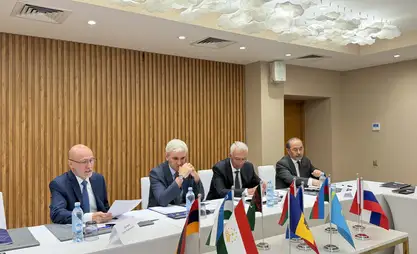

Issyk-Kul, Aug. 30, 2026 /Kabar/. State news agencies of the CIS countries have been proposed to create a common information space for travel across Eurasia. This proposal was voiced by Igor Grigoriev, Head of the Information and Informatization Department of the CIS Executive Committee, at the 35th meeting of the Council of Heads of State News Agencies of the CIS, which is taking place in Issyk-Kul.
According to him, tourism today is not only a significant sector of the economy, but also one of the most natural forms of communication, mutual understanding, and building trust between countries and peoples.
"Tourism is largely an economy of trust." "People travel to another country when it's understandable and presented in an engaging way," Grigoryev noted.
In this regard, he proposed developing cooperation between news agencies in several areas.
The first area could be the regular exchange of verified tourism content—texts, photographs, videos, infographics, calendars of significant events, and brief reference materials.
Particular attention, he said, should be paid not only to capital cities and well-known tourist destinations, but also to smaller historic towns, natural areas, national parks, crafts, and local cultural traditions. This will expand the geography of mutual tourist travel.
To organize such work, it is proposed to create a mechanism for the regular exchange of reliable tourism materials between state news agencies using the website of the Council of Heads of CIS State News Agencies (ANIA), as well as to identify contact editors and coordinators for this area.
The second area could be the joint presentation of interstate and cross-border tourist routes. Grigoryev named the Great Silk Road, ancient cities of Eurasia, mountain nature trails, Orthodox, Islamic, and Buddhist heritage, traditional crafts, as well as spa and wellness tourism as potential topics.
"Many such topics naturally connect several countries," he noted.
Grigoryev also suggested exploring the possibility of creating joint multimedia series dedicated to interstate tourist routes and lesser-known destinations in the region.
He said special attention should be given to the exchange of practical information for travelers—entry regulations, transportation, payment methods, mobile communications, and other issues.
"A common editorial format would be useful, for example, a brief pre-trip card outlining what you need to know," he said.
Furthermore, a representative of the CIS Executive Committee proposed conducting joint cross-border press expeditions, where representatives of several national news agencies could travel a single international route together and present it to their audiences from different cultural and editorial perspectives.
A possible pilot project proposed would be the creation of a joint information series, "Eurasia Travel," dedicated to ancient cities, natural areas, and other tourist destinations in the region's countries.
"The formula 'several countries, one route, several editorial offices' makes it possible to simultaneously create lively content and present Eurasia as a connected space of human, cultural, and historical contacts," Grigoryev emphasized.
He noted that joint work by state news agencies of the CIS countries could contribute to the expansion of mutual tourist flows, support for regions, and the formation of a more accurate understanding of each other's societies, as well as the cultural, historical, and natural diversity of the Commonwealth countries.