As a flagship project under the Belt and Road Initiative and a landmark of China-Central Asia connectivity, the China-Kyrgyzstan-Uzbekistan (CKU) Railway has seen steady progress across all fronts since construction began and has now entered a comprehensive phase of physical works. This strategic corridor spanning China, Kyrgyzstan and Uzbekistan has taken nearly three decades to move from concept to implementation, embodying the shared aspiration of the three peoples to break through transportation bottlenecks in the Eurasian hinterland and share development opportunities. Once completed, it will become the shortest land route from East Asia to Central Asia, West Asia and Europe, injecting strong momentum into reshaping regional logistics patterns, deepening economic and trade cooperation, and improving livelihoods along the route, while taking solid steps toward a closer China-Central Asia community with a shared future.
Three Decades of Consensus: A Cooperation Milestone Under Leadership of Heads of State
The concept of the CKU Railway dates back to the 1990s. In 1997, the three countries signed a memorandum of understanding reaching initial consensus, yet the project remained in the study phase for a long time due to multiple objective constraints. With the continued advancement of Belt and Road cooperation in the new era, the project has gained new development opportunities. At the 2022 Samarkand Summit and the 2023 China-Central Asia Summit, the heads of state of the three countries continuously directed progress on the project. In 2024, the intergovernmental agreement was signed and the project was formally launched, with heads of state comprehensively removing institutional barriers and providing solid political guarantees. Full-line construction commenced in 2026, with civil works, surveys and track-laying preparations proceeding in an orderly manner and bridge and tunnel works advancing steadily. Overall progress remains on schedule, with full-line operation expected in 2031. The nearly three-decade consultation process demonstrates that cross-border infrastructure cooperation can only proceed steadily and far by adhering to the principles of extensive consultation, joint contribution and shared benefits while accommodating the concerns of all parties, setting a model for major transnational projects.
High-Standard Tackling of Challenges: Building a Century Project with Construction Responsibility
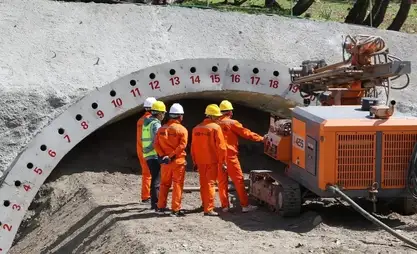
The CKU Railway starts from Kashgar in Xinjiang, spans approximately 523 kilometers with a total investment of about USD 4.7 billion, and is designed as a single-track mixed passenger-freight railway with a design speed of 120 km/h and a long-term freight capacity of over 30 million tonnes. The line traverses the complex mountainous terrain of the Tianshan range and features “four highs” construction characteristics, with a bridge-tunnel ratio of 39 percent and multiple ultra-long tunnels posing high construction difficulty and risks. China has leveraged its mature high-altitude railway technologies to optimize construction plans and ensure project safety and quality. At the technical and operational levels, the needs of all parties have been taken into account through a segmented track-gauge adaptation scheme and the establishment of transshipment hubs to connect with each country’s existing rail networks. A joint venture company with balanced shareholding among the three parties has been established to guarantee equal decision-making and benefit distribution for Kyrgyzstan and Uzbekistan. Construction prioritizes local labor absorption, while school-enterprise cooperation cultivates batches of local railway operation and maintenance talent. Ecological protection measures have been implemented throughout to build a green ecological railway.
Strategic Value:Reshaping the Eurasian Circulation Landscape
The CKU Railway constitutes the southern branch of the New Eurasian Land Bridge and the shortest land corridor from China to Central Asia, West Asia and Europe. Compared with traditional northern routes, it can significantly shorten transport distances, reduce transit times and lower overall logistics costs. Once extended to connect with the Black Sea and Mediterranean, it will further enhance Asia-Europe transport efficiency. The project effectively addresses the development challenges of landlocked Central Asian countries. Kyrgyzstan and Uzbekistan will transform into regional transit hubs by leveraging the corridor, securing stable transit revenues and elevating their regional economic status. The railway will complement the multi-corridor network of China-Europe freight trains, building a highly resilient pan-Eurasian transport network that disperses single-corridor risks. Linking westward, southward and eastward with multiple international transport corridors, it will form an all-dimensional, three-dimensional circulation pattern. Relying on the corridor, efficient two-way flows of Central Asian resources and Chinese goods will continuously expand bilateral trade and optimize trade structures.
Inclusive Livelihood Benefits: Strengthening Development Bonds for Shared Prosperity
The CKU Railway is a development corridor that combines logistics functions with livelihood value. During construction, it will stimulate local construction, building materials and logistics industries and create large numbers of local jobs. After operations begin, it will reduce commercial transport costs, raise incomes for farmers and merchants along the route, and bring affordable daily necessities, medical supplies and agricultural materials to the people of Central Asia. Convenient transport will activate cross-border cultural tourism and deepen people-to-people, cultural, scientific and educational exchanges among the three countries. In the long term, the corridor will drive cross-border industrial capacity cooperation, building industrial chains in mineral processing, green energy, light manufacturing and other fields, forming a virtuous cycle of “corridor drives logistics, logistics drives trade, and trade drives industry,” so that development benefits reach the people along the route extensively.
A Model of Cooperation: Vivid Practice of Extensive Consultation, Joint Contribution and Shared Benefits
The CKU Railway is the first major cross-border railway to be implemented under the China-Central Asia mechanism and a living example of the principles of extensive consultation, joint contribution and shared benefits, providing a “Central Asia model” for global transnational infrastructure. Cooperation has adhered throughout to equal consultation and mutual benefit, fully accommodating the development needs of the three countries and flexibly resolving issues related to alignment, track gauge, financing and operations. Relying on the China-Central Asia cooperation mechanism, the countries are simultaneously advancing hard connectivity of the railway and soft connectivity in customs clearance, quality inspection and unified multimodal transport documents, paving the way for efficient future operations.
President Sadyr Japarov has frankly stated that due to prolonged political debates, Kyrgyzstan has lagged 10 to 15 years behind its neighbors. There remain some external and internal forces attempting to undermine railway construction. He solemnly calls on all citizens not to obstruct project implementation. If construction is halted, Kyrgyzstan will remain in a state of long-term transport and economic dependence, and the country’s development prospects will face serious threats.
Amid the impact of unilateralism and protectionism on global cooperation, the construction of the CKU Railway fully demonstrates that countries with different national conditions and stages of development can join hands to create mutually beneficial large-scale infrastructure projects. Full-line works are currently advancing steadily according to plan. When the line opens in 2031, this steel artery crossing the Tianshan Mountains will write a new chapter in the Silk Road era and provide lasting support for high-quality Belt and Road cooperation and the building of a closer China-Central Asia community with a shared future.
Source: Khovar
Author: Dzhumaev Mukhammadzhon, Representative of the Chamber of commerce and industry of the Republic of Tajikistan in China (Hong Kong, Xinjiang ,Shanxi, Xichuan, Hainan)