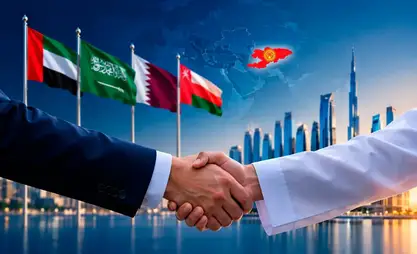

Bishkek, Nov. 10, 2026 /Kabar/. Businesses from the Persian Gulf states see significant prospects in Central Asia. Investors are drawn to this dynamically developing region, which boasts a growing economy, rising household incomes, and increasing consumer and investment demand.
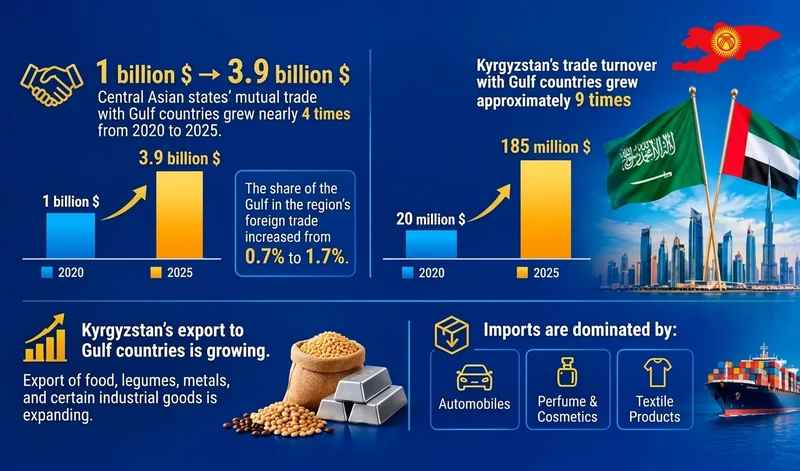
According to the Eurasian Development Bank (EDB), trade between Central Asian nations and the Gulf states grew nearly fourfold from $1 billion to $3.9 billion between 2020 and 2025. Analysts note that the Gulf’s share in the region’s foreign trade has risen from 0.7% to 1.7%.
Furthermore, the additional trade potential through 2030 is estimated at $4.9 billion, representing a 25% increase over current trade turnover figures. This growth will be supported by the development of transport routes, a reduction in logistics costs, and trade liberalization including through the free trade agreement between the Eurasian Economic Union and the United Arab Emirates, which entered into force in October 2026.
Over the past five years, the cumulative investment from Gulf states in Central Asia has grown 3.4 times, rising from $9.1 billion to $31.1 billion.
Investments are being actively directed toward the electric power sector; its share has climbed from 2% to 34%, with the cumulative volume reaching $10.5 billion. The primary driver behind this is a series of large-scale solar and wind energy projects. The UAE remains the leading investor from the Gulf region, with $20.6 billion (accounting for 66% of the total portfolio). Meanwhile, the presence of Saudi Arabia ($6.5 billion) and Qatar ($3.1 billion) is growing rapidly.
Trade and investment ties are set to continue expanding, driven by economic growth in Central Asia, the international business expansion of Gulf nations, and strengthened economic cooperation within the Islamic world.
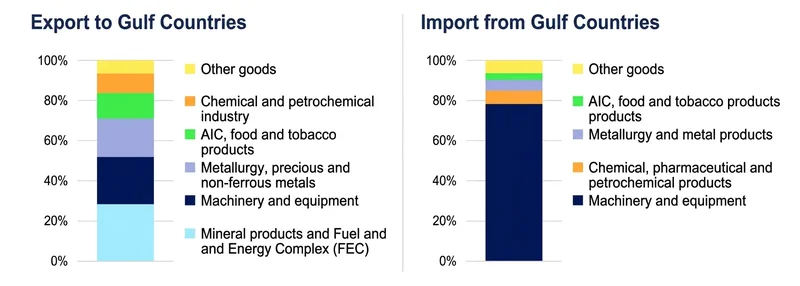
Bilateral trade remains structurally asymmetric: approximately 70% of trade turnover consists of exports from Gulf countries to Central Asia, primarily machinery and equipment, vehicles, electronics, pharmaceuticals, and chemical products. Central Asia functions, on the whole, as a net importer; furthermore, a portion of the goods arriving from the UAE consists of re-exports, reflecting the Emirates' role as a major international trade and logistics hub.
As for Kyrgyzstan, the country is experiencing one of the fastest growth rates in trade with the Gulf states. Between 2020 and 2025, trade turnover increased approximately ninefold from $20 million to $185 million.
Kyrgyz exports serve as the primary driver of this growth. Analysts note an expansion in the export of food products, legumes, metals, and certain industrial goods. Imports, meanwhile, are dominated by automobiles, cosmetics, perfumes, and textile products.