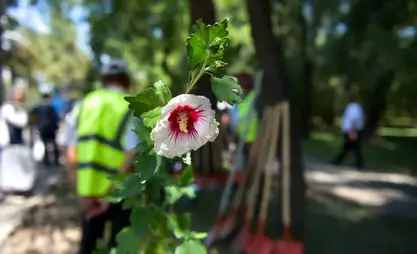
Bishkek, Aug. 20, 2026 /Kabar/. An environmental campaign to plant 70 hibiscus bushes – Korea’s national flower, known in Korean as mugunghwa – was held at the Kyrgyzstan-Korea Friendship Park in Bishkek on August 19.
Bringing together representatives of Kyrgyzstan and the Republic of Korea as well as young volunteers, the initiative combined urban greening with a broader message of friendship and environmental cooperation between the two countries, according to the Bishkek Mayor’s Office.
The event was attended by Bishkek Mayor Aibek Dzhunushaliev, Ambassador of the Republic of Korea to the Kyrgyz Republic Kim Kwang-jae, young volunteers from Gyeonggi Province, representatives of the Kaya KJI Public Charitable Foundation, and members of the Youth Advisory Council under the Department of Physical Culture and Sports, Tourism and Youth Affairs of the Bishkek Mayor’s Office.
Addressing the participants, Ambassador Kim Kwang-jae thanked the Korean volunteers for travelling to Kyrgyzstan and taking part in the initiative despite the hot weather. He particularly highlighted the involvement of young people from Gyeonggi Province and their willingness to work alongside local residents on an environmental project.
“Each tree we plant today is more than just a tree. As its name suggests, the Korea-Kyrgyzstan Friendship Park is a space symbolizing friendship between Korea and Kyrgyzstan. The trees you are planting here embody our wish that the friendship between our two countries will continue to grow deeper and stronger,” he said.
The ambassador expressed hope that the initiative would contribute to bringing the peoples of the two countries even closer and encourage further exchanges.
“I hope today’s gathering will become another opportunity for Korea and Kyrgyzstan to grow closer and will lead to expanded exchanges and cooperation in various fields, including the environment, youth and culture,” Kim Kwang-jae added.
Bishkek Mayor Aibek Dzhunushaliev noted that such initiatives contribute not only to improving Bishkek’s urban environment but also to strengthening friendship and cooperation between Kyrgyzstan and the Republic of Korea.
“Today, we are not simply planting bushes; we are creating another symbol of friendship between our peoples. Cooperation in the areas of environmental protection, combating climate change and improving the urban environment is of particular importance to us. I thank the young people for taking part in this initiative, and I am confident that such positive initiatives will continue,” Dzhunushaliev said.
For the initiative, the choice of hibiscus carries particular symbolism. Hibiscus syriacus, or mugunghwa, is the national flower of the Republic of Korea and is deeply associated with the country’s national identity. Planting the flower in a park dedicated to Kyrgyz-Korean friendship therefore adds another symbolic element to a public space that already reflects decades of relations between the two countries.
The Kyrgyzstan-Korea Friendship Park itself holds symbolic significance in bilateral relations. Located at the intersection of Baitik Baatyr, Isa Akhunbaev and Kasymaly Jantoshev streets in Bishkek, the public space was officially named the Friendship Park between the Kyrgyz Republic and the Republic of Korea by the Bishkek City Council on November 9, 2022. The decision came in the year when Kyrgyzstan and the Republic of Korea marked the 30th anniversary of the establishment of diplomatic relations.
Over the years, the park has evolved into one of Bishkek’s public spaces most closely associated with Kyrgyz-Korean ties. The planting of 70 hibiscus bushes adds a new layer to that symbolism: Korea’s national flower is now taking root in the Kyrgyz capital.
Beyond its symbolic dimension, the initiative highlights the growing role of youth and people-to-people contacts in relations between Kyrgyzstan and Korea. By bringing Korean volunteers together with local participants, the campaign demonstrated how cooperation can extend beyond official diplomacy into environmental protection, culture, youth exchanges and everyday interaction between the two societies.
As the newly planted hibiscus bushes grow in the heart of Bishkek, they will serve not only as part of the city’s green landscape, but also as a living reminder of a friendship that both countries hope will continue to deepen for years to come.