
Bishkek, Oct. 21, 2026. /Kabar/. The draft of the country’s primary financial document, the budget for 2027–2029 has been submitted to Jogorku Kenesh (Kyrgyz Parliament). According to experts, the projected figures confirm the stability of the economic situation and the viability of Kyrgyzstan’s development projects.
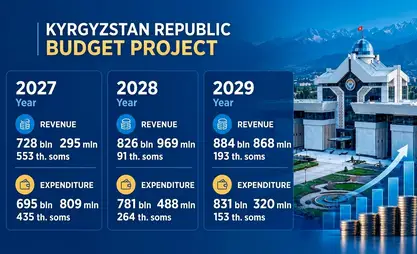
The presented parameters indicate that the national economy will continue to gain momentum. The budgets are projected to show a surplus, with the gap between state revenue and expenditure expected to widen year after year from 32.5 billion soms next year to 53.5 billion soms by 2029. For comparison, the surplus for the current year was set at 0.4 billion soms.
Below are the key projected indicators presented in the document:
The primary driver of revenue growth is tax receipts. To illustrate: while tax revenue stands at 460.8 billion soms this year, it is expected to reach 779.9 billion soms by 2029, an increase of nearly 70%. This points to an anticipated economic expansion, maintaining a pace consistent with current trends. The priority now is to sustain this momentum; doing so will ensure that Kyrgyzstan can navigate even the peak of its external debt repayment obligations with a solid financial cushion.
Economists highlight the particular significance of the fact that, alongside a near-doubling of social spending and the fulfillment of all external debt obligations, substantial funds are being allocated toward development projects. This indicates that the economy is transitioning to a stage of strategic stability, where business and commercial activity generate sufficient tax revenue to cover core needs, while also allowing for the allocation of funds toward the social sector and programs requiring additional support. Furthermore, a reserve of resources will remain in the state treasury.
Regarding expenditure items that often attract significant public attention, experts highlight that funding for education is set to increase to 127.2 billion soms by 2027, nearly double the amount allocated for 2025. Budgetary allocations for social protection will also double, and the healthcare sector will receive a substantial boost (+30%).
It is hard to disagree with the economists: the budget is balanced, provides significant funding for development goals, and is, at the same time, socially oriented. The state is directing a substantial portion of its revenue growth toward improving the standard of living for its citizens.