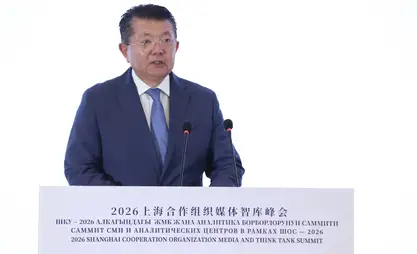

Bishkek, July 27, 2026. /Kabar/. The Shanghai Cooperation Organization is entering a new stage of development, where the main issue is not further expansion, but the effectiveness of joint work between states. Alikbek Dzhekshenkulov, former Minister of Foreign Affairs of Kyrgyzstan and professor at the Kyrgyz-Russian Slavic University speaks at the 2026 SCO Media and Analytical Center Forum in Bishkek.
According to him, international organizations play an important role in strengthening the sovereignty of states and creating mechanisms for practical cooperation.
"In any large international organization, there is a natural division of roles. Major powers determine the size of the association, its political weight, and its resources. But the development of the institutions themselves, the transformation of declarations into real mechanisms of cooperation, is often ensured by small and medium-sized states," noted Dzhekshenkulov.
He emphasized that the intellectual dimension of SCO is no less important than its political and economic dimensions. According to him, the meaning and future of the organization are shaped by the work of the expert community, research centers, and the media.
"Discussions about the role of analysts and journalists are not an add-on to policy, but an integral part of it," the professor stated.
Dzhekshenkulov noted that the SCO currently unites 10 member states and has reached an important stage in its development. In his opinion, in the next decade, the main question will not be who else will join the organization, but how effectively countries can work together.
"The time is coming for a transition from expansion to the quality of cooperation," he emphasized. He placed particular emphasis on the role of think tanks and media outlets, which, he said, help bridge the gap between political decisions and their practical implementation.
The professor proposed focusing on three areas: filling existing SCO institutions with real content; developing joint research on key issues such as transport, security, climate change, water resources, and digital technologies; and strengthening ties between experts and journalists.
"Analysts without public opinion remain unnoticed, and the news agenda without serious analysis quickly turns into noise. Only together can they form an objective understanding of processes within the SCO," he noted.
Dzhekshenkulov also emphasized the special role of Central Asian countries in the organization's development, noting that it is important for states not only to follow the lead of major players but also to co-author a common agenda, proposing ideas and practical solutions.
"Sovereignty is not measured by the size of a state, but by the ability to propose well-developed ideas and implement concrete actions," he said.
According to him, preserving the SCO's principles dialogue, equality, and cooperation is the responsibility not only of diplomats but also of the expert community.
"Today's forum should contribute to strengthening mutual understanding and building a common SCO home not only through political decisions but also through shared intellectual work," concluded Alikbek Dzhekshenkulov.