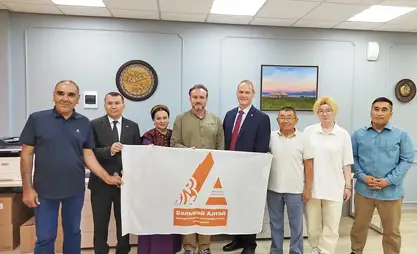
Bishkek, Aug. 11, 2026 /Kabar/. The international ethnographic expedition "Great Altai: Turkic Heritage 2026" has launched in the Altai Krai and the Altai Republic.
This year's highlight was the expansion of the participants' geographic reach. The research team from the Altai State University's "Great Altai" Research and Educational Center for Altaic and Turkic Studies included scientists from Kyrgyzstan, Tajikistan, Turkmenistan, and Uzbekistan. Thus, the project brought together representatives from five countries, making it the most multinational in the expedition's history.
The main scientific goal of the expedition is to identify ethnocultural parallels between the peoples of Altai and Central Asia and to trace surviving connections in traditional households, housing, clothing, food, social relations, kinship terms, and beliefs.
Of particular significance for Kyrgyzstan is the fact that the project's first international ethnographic expedition took place in Kyrgyzstan in 2021. In subsequent years, scientists conducted research in the Altai Mountains, the Altai Republic, and Uzbekistan.
Expedition leader Ivan Nazarov, Director of the Institute of History and International Relations at Altai State University, noted that Altai occupies a special place in the history of the Turkic peoples. He noted that many modern Turkic-speaking peoples of Altai and Central Asia retain the idea of Altai as their historical homeland.
The first stop on this route was Biysk, where the participants met with a Kumandin community. Elders told the researchers about the traditional fire worship rite, gave them a tour of the ethnocenter, and presented them with national dishes.
The expedition will then head to the Turochak District of the Altai Republic, and then to the Ust-Kansky and Ust-Koksinsky Districts. Here, scientists will focus on studying the traditional culture of the southern Altai people.
For 10 days, the researchers will collect field data that will form the basis for scientific publications and a comparative study of the cultural ties between the peoples of Altai and Central Asia.
For the first time this year, the project also received support from the Altai Regional Branch of the Russian Geographical Society. Photographs taken during the expedition are planned to be presented in a traveling exhibition that will be held in the fall at universities, museums, and other venues.
The "Greater Altai" project is being implemented by Altai State University as part of the Scientific and Educational Center for Altaic and Turkic Studies. Since 2024, Gorno-Altai State University has been its permanent co-organizer.