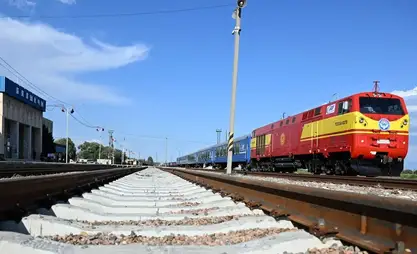
Bishkek, Aug. 3, 2026 /Kabar/. The Balykchy – Kochkor – Kara-Keche – Makmal railway will be a strategic project that will connect the north and south of Kyrgyzstan and give new impetus to the country's economic development. Azamat Sakiev, General Director of the state-owned enterprise "Kyrgyz Temir Zholu", (Kyrgyzstan's railways) told Birinchi Radio.
He recalled that the ceremonial opening of the first 63-kilometer Balykchy-Kochkor railway line took place on July 25th, with the participation of Kyrgyz President Sadyr Zhaparov. Sakiev noted that this project is of historic significance for the country, as it marks the first time in 78 years that Kyrgyzstan has begun building railway lines on its own.
"We ourselves, using our company's resources, with our own hands, and with the help of railway workers, have begun building this large megaproject," he said.
The head of Kyrgyz Temir Zholu noted that the development of railway infrastructure is a key factor in economic growth, as logistics directly impacts the cost of goods and the development of trade.
According to him, work on the project will continue after the completion of the first phase. A feasibility study is currently being prepared for the construction of the next sections to Kara-Keche and further to Makmal.
"The Balykchy-Kochkor-Kara-Keche-Makmal project is strategically important, as it will connect the north and south of the country by rail. This will enable freight transportation, reduce logistics costs, relieve road congestion, and improve transportation safety," he noted.
Speaking about the financing of the Balykchy-Kochkor railway construction, Azamat Sakiev emphasized that the project was implemented using the company's own funds.
According to him, foreign investors had previously been considered, but the construction costs offered by foreign companies ranged from $5 to $8 million per kilometer. Ultimately, domestic specialists built the section of the railway significantly more affordably, costing approximately $955,000 per kilometer.
"I can proudly say that this is a very low cost. We have proven that we can build high-quality work ourselves," emphasized the head of Kyrgyz Temir Zholu.