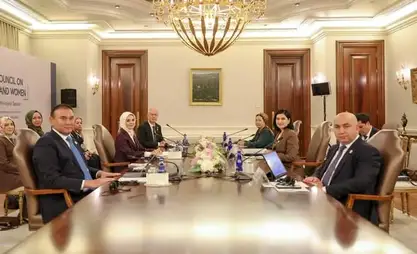

Bishkek, Nov. 2, 2026 /Kabar/. Almaz Imangaziev, Minister of Labor, Social Security and Migration of Kyrgyzstan, participated in a meeting of ministers responsible for family and women’s affairs, held on the sidelines of the 13th Summit of the Organization of Turkic States (OTS) in Ankara, the ministry reports.
During the meeting, participants discussed strengthening the institution of the family, protecting children, expanding opportunities for women, and fostering cooperation among Turkic states in the social sphere.
Speaking at the ministerial session, Almaz Imangaziev emphasized that supporting families, motherhood, and fatherhood, improving the well-being of the population, and creating favorable conditions for raising children are key priorities of Kyrgyzstan’s state policy.
The minister highlighted the issue of women’s leadership, noting that the country is currently implementing a State Program to Support Women’s Leadership, which runs until 2030. Furthermore, following reforms to electoral legislation, the share of women in the Jogorku Kenesh (Parliament) has reached 33%, up from 22% in the previous convocation.
The minister also outlined challenges shared by the Turkic states, including demographic shifts, support for young families, the prevention of violence against women and children, countering cyber-violence, and ensuring child safety in the digital environment.
Almaz Imangaziev expressed his support for Turkiye’s initiative to establish an OTS Council on Family and Women’s Affairs, underscoring the importance of sharing expertise, developing joint initiatives, and achieving practical outcomes for the benefit of families, women, and children.
As part of his working visit, the minister also toured the Saray Engelsiz Yaşam (Saray Barrier-Free Living) Center for care, rehabilitation, and family support, where he learned about how care and rehabilitation services for individuals with disabilities are organized, the conditions in which they stay, and the approaches used to provide social support to their families.