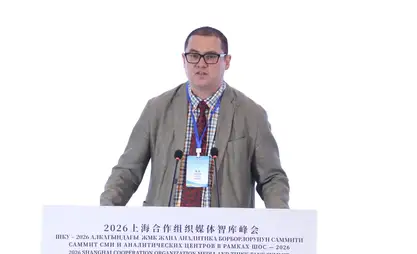

Bishkek, July 27, 2026 /Kabar/. The Shanghai Cooperation Organization (SCO) has undergone significant institutional transformations since its founding and has become one of the largest and most effective regional organizations in the world. Mirzohid Rakhimov, department head at the Center for contemporary history of Academy of Sciences of Uzbekistan told at media and think tanks forum in Bishkek.
According to him, the SCO currently comprises 10 member states, as well as 16 partner and observer countries. The organization has begun to play a key role not only regionally but also globally.
"The SCO countries possess a rich historical and civilizational heritage, united by the Great Silk Road. Today, joint projects in education, culture, and other areas are a continuation of this cooperation," Rakhimov noted.
He emphasized that cooperation between China and the Central Asian countries has expanded significantly in recent years. According to him, bilateral trade turnover has grown from $50 million to $106 billion, demonstrating a new level of interconnectedness.
Rakhimov also noted that transport and communications projects within the Belt and Road Initiative are strengthening ties between China, Central Asia, Europe, and West Asian countries.
He noted that SCO countries are currently facing global and regional challenges, and in these circumstances, close coordination and exchange of experience between countries is particularly important.
"Central Asian countries can learn a lot from the experience of other states, including in the areas of governance systems, technological development, and green policies," said the Uzbek expert.
Rakhimov emphasized the need to further develop joint scientific research within the SCO, adding that cooperation that ensures the unity of various civilizations should remain the organization's key focus.
"Today, a comprehensive partnership is needed. Joint research and exchange of experience among SCO countries will contribute to strengthening mutual understanding and sustainable development," Rakhimov concluded.