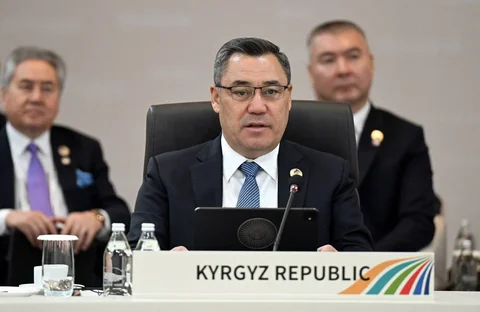
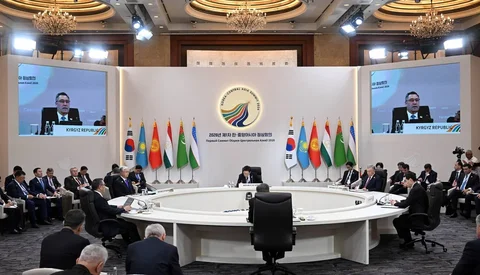

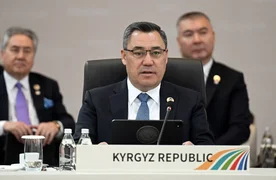
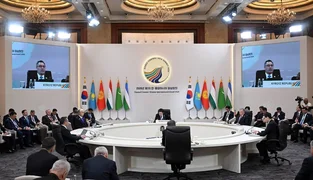

Bishkek, Sept. 16, 2026 /Kabar/. Today, September 16, President of Kyrgyzstan Sadyr Zhaparov addressed the inaugural "Central Asia – Republic of Korea" Summit in Seoul as part of his official visit to the Republic of Korea.
The event was also attended by President of Kazakhstan Kassym-Jomart Tokayev, President of Tajikistan Emomali Rahmon, tPresident of Turkmenistan Serdar Berdimuhamedov, President of Uzbekistan Shavkat Mirziyoyev, and tPresident of Korea Lee Jae-myung.
In his speech, Sadyr Zhaparov noted that the summit opens a new chapter in the development of cooperation. He highlighted the large-scale transformations that have taken place in Central Asia, which has evolved in recent years into a dynamic, cohesive, and economically interconnected region.
He said that these processes are underpinned by the strengthening of mutual trust, regional cooperation, and an understanding of shared long-term interests. A stable and prosperous Central Asia serves the interests not only of the region's peoples but also of its international partners.
President Zhaparov specifically highlighted the high level of regional solidarity, evidenced by the Central Asian countries' unanimous support for Kyrgyzstan’s candidacy as a non-permanent member of the UN Security Council for the 2027–2028 term. Sadyr Zhaparov described this decision as a sign of deep trust and responsibility, emphasizing that, as a member of the UN Security Council, Kyrgyzstan would consistently uphold the principles of peace, preventive diplomacy, and international law.
Zhaprov described the Republic of Korea as a reliable partner for Central Asia, noting the mutually beneficial cooperation established in recent years across trade, investment, transport, energy, digitalization, and education.
"The key task at this stage is to translate high-level political trust into a long-term economic and technological partnership," the president emphasized.
He noted that the potential of a dynamically developing Central Asia—with its young population, resources, and strategic transit location—is complemented by the capabilities of the Republic of Korea, a global leader in technology, industry, and innovation.
In this context, Sadyr Zhaparov outlined several priority areas for cooperation.
He proposed strengthening the coordinating role of the Foreign Ministers' meetings within the "Central Asia – Republic of Korea" format by empowering this mechanism to provide political oversight and monitor the implementation of agreements reached.
In the economic sphere, he advocated for the creation of a Council of State Investment Agencies within the existing Consultative Mechanism of Ministers of Industry, the formation of a unified portfolio of major projects, and the establishment of a joint investment fund to finance priority initiatives, localize production, and facilitate the entry of Korean businesses into Central Asian markets.
Particular attention was paid to technological cooperation, the implementation of artificial intelligence, and digitalization. In this context, the president proposed establishing a network of joint pilot technology hubs.
Addressing the climate agenda, Sadyr Zhaparov proposed the creation of a Partnership for Climate Resilience in Mountain Regions and invited participants to the "Bishkek+25" Global Mountain Summit in 2027. He also outlined prospects for cooperation in clean energy, hydropower, and green mobility.
Human capital development featured prominently in his address. The head of state called for making this a cornerstone of cooperation by expanding educational programs, academic exchanges, and joint research initiatives.
"It is precisely investments in the knowledge, professional skills, and talents of our citizens that must form the solid foundation for technological renewal, sustainable economic growth, and the long-term competitiveness of our countries," Sadyr Zhaparov noted.
In conclusion, the head of state expressed confidence that the summit and the adopted Seoul Declaration would provide fresh momentum to cooperation and serve as the basis for a practical action plan featuring concrete projects and benchmarks for the coming years.
He emphasized that by the next meeting, the "Central Asia – Republic of Korea" format must demonstrate tangible results—such as launched production facilities, attracted investments, implemented technologies, and new opportunities for citizens.
"Political will must be transformed into practical achievements," President Sadyr Zhaparov concluded, reaffirming the Kyrgyz Republic's readiness for active and fruitful collaboration.