Chairman of Turkmenistan’s Halk Maslahaty Gurbanguly Berdimuhamedov has expressed confidence that Turkish companies will make a significant contribution to implementing Turkmenistan’s National Industrial Development Strategy for 2030-2045, the press service of the Turkmen government reports.
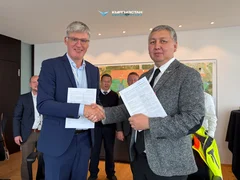
He made the remarks during a meeting with Ahmet Çalik, Chairman of the Board of Directors of Çalik Holding, held as part of his working visit to Türkiye.
During the meeting, Berdimuhamedov noted the dynamic development of cooperation between Turkmenistan and Türkiye across several sectors, particularly energy, textile manufacturing and construction.
He said Turkmenistan was creating favorable conditions for expanding cooperation with foreign partners and implementing joint projects.
Çalik thanked the Turkmen leadership for the opportunities provided to Turkish businesses in the country and said participation in major infrastructure projects in Turkmenistan was a matter of honor for his company.
He also assured Berdimuhamedov that Turkish partners would continue to fulfill their commitments responsibly, completing work on assigned projects on time and to a high standard.
The meeting also covered the recent visit of Turkish President Recep Tayyip Erdoğan to Turkmenistan and the awards conferred on President Serdar Berdimuhamedov during his visit to Türkiye.
For reference, Turkish contractors have been among the most prominent foreign players in Turkmenistan for decades, particularly in construction, energy and industrial infrastructure. According to Türkiye’s Trade Minister Ömer Bolat, Turkish companies had completed 1,098 projects in the country worth a total of $56 billion as of February 2026.
Around 30 Turkish companies operate in Turkmenistan, including Çalık Holding, GAP İnşaat, Rönesans and İlk İnşaat. The value of ongoing contracts was estimated at approximately $7.5 billion in 2025, while a further $10 billion worth of projects is expected in the coming years, including the next phase of construction of the city of Arkadag.
Çalık Holding is among the most active Turkish investors and contractors in the country. Through its subsidiary Çalık Enerji, the group built the Mary-3 combined-cycle power plant, the first of its kind in Turkmenistan, with a capacity of 1,574 megawatts, commissioned in 2018. The company is also building a similar power plant in the Turkmenbashi district of Balkan region, along with transmission lines. In August 2024, it was authorized to sign a contract with Turkmengaz State Concern for the construction of the Shatlyk-1 gas compressor station in Mary region, with commissioning scheduled for September 2026.
Another subsidiary, GAP İnşaat, has been involved in several major infrastructure projects, including the Turkmenbashi International Seaport, the Garabogaz ammonia and urea plant, the Archabil highway and medical facilities in Ashgabat. In September 2025, the company and Japan’s Mitsubishi Heavy Industries received government approval to build a new urea complex in the Turkmenbashi district, with an annual production capacity of 1.155 million tonnes and completion planned for 2030.
Rönesans Holding is another major Turkish contractor with a portfolio spanning industrial, energy and infrastructure projects. Through Rönesans Endüstri, it has been involved in the construction of an ammonia and urea plant in Mary, a gas-to-gasoline complex in Akhal region, an ethane cracker and polyethylene and polypropylene plants in Kiyanly, as well as a 432-megawatt power plant in Lebap region. Its portfolio also includes a urea-formaldehyde concentrate project in Ashgabat and work on modernizing the Kiyanly polymer plant.
Trade ties provide another indication of the scale of Turkish business activity in Turkmenistan. Bilateral trade reached $2.173 billion in 2025, compared with $2.166 billion in 2024. Turkish exports amounted to $1.3 billion and included metal structures, electrical conductors, marble, travertine and aluminum products, while imports from Turkmenistan totaled $860 million and included crude oil, natural gas, cotton yarn and textiles.
Turkish companies have established a strong position in the market through their experience in delivering turnkey projects, covering design, equipment supply, construction and commissioning. Their role increasingly extends beyond construction contracts to participation in long-term industrial projects. Continued interest in the market was also highlighted by Bolat’s meeting with Turkish business representatives in Ashgabat in February 2026 and Çalık Enerji’s role as general partner of the CIET 2026 conference.
Trend has examined in greater detail the role Turkish businesses have come to play in Turkmenistan’s economic landscape in an analytical article titled “Inside Turkmenistan’s investment cycle: How Turkish contractors anchor a new phase of economic expansion.”