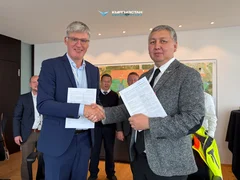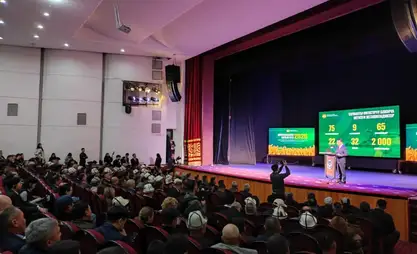

Bishkek, Oct. 23, 2026 /Kabar/. This year has been a productive one for the agricultural sector, with significant work carried out and notable results achieved within Kyrgyzstan’s agriculture and processing industries. Erlist Akunbekov, Deputy Chairman of the Cabinet of Ministers and Minister of Water Resources, Agriculture and Processing Industry of the Kyrgyz Republic spoke during the opening ceremony of the "AgroTechExpo-2026" exhibition and the "Altyn Kuz" (Golden Autumn) fair. He took the opportunity to congratulate agricultural workers, farmers, entrepreneurs in the processing industry, investment partners, and ministry staff on the occasion of the Day of Workers of the Agro-Industrial Complex of Kyrgyzstan.
According to him, thanks to the dedicated efforts of farmers and agricultural producers, the value of agricultural output for the first nine months of 2026 reached 399.5 billion soms, a growth rate of 106.5% compared to the same period last year.
The minister noted that the processing sector handled products valued at 92.7 billion soms, with a physical volume index of 109.4%.
"The sector has seen the establishment of 75 large and medium-sized enterprises, 9 trade and logistics centers, 65 cooperatives, and 22 machine-tractor stations. Furthermore, 1,724 units of agricultural machinery have been provided through leasing, 2,000 new jobs have been created, and international quality standards have been implemented at 32 enterprises," said Akunbekov. He emphasized that significant work has been carried out in recent years to expand the export reach for agricultural products, and added that food security is being consistently maintained.
Erlist Akunbekov explained that while state support for agriculture and the processing industry was previously channeled through two projects, it is now being implemented via eight separate projects this year.
According to him, within the framework of these projects, 10,453 business entities received preferential loans totaling 12 billion 537 million soms during the first nine months of the current year. Furthermore, he emphasized that the implementation of projects under the State Investment Program as a form of government support, makes a significant contribution to the development of the agro-industrial complex.
The minister added that, in order to process 25% of the raw agricultural output, it is necessary to commission 385 large-scale enterprises, 40 trade and logistics centers, 180 fruit and vegetable storage facilities, and 40 warehouses for material and technical resources. It is also essential to further expand the cluster-based production model and double the export of agricultural products.
He noted that by 2030, drip irrigation systems must be installed across 60,000 hectares, 3,279 hectares of new irrigated land must be brought into operation, and the irrigation water supply for 6,969 hectares of land must be improved.