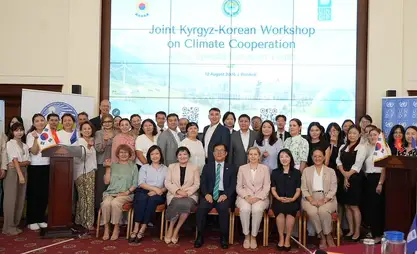
Bishkek, Aug. 13, 2026 /Kabar/. Kyrgyzstan's climate policy has moved from isolated initiatives to a unified state system. In turn, the promotion of the Mountain Agenda at the international level has cemented Kyrgyzstan's status as a leader among mountain countries. Bishkek discussed climate change issues during joint Kyrgyz-Korean dialogue. The seminar was organized by the Korean Embassy in Kyrgyzstan, the United Nations Development Programme (UNDP), and the Ministry of Natural Resources, Environment, and Technical Supervision of the Kyrgyz Republic, with the participation of industry experts, officials, and scientists.
Kyrgyzstan discussed climate issues with Korean specialists. The framework agreement on cooperation on climate change between Kyrgyzstan and Korea entered into force in 2025. At this stage, it is necessary to begin the practical implementation of the agreement and strengthen the bilateral dialogue on sustainable development. At the first workshop organized for these purposes, participants discussed issues of green energy, climate adaptation, climate finance, carbon regulation, transparency, digital innovation, and youth participation.
In turn, Kyrgyzstan is advancing the implementation of the updated Nationally Determined Contributions (NDC 3.0) and strengthening climate adaptation measures, as well as exploring climate finance opportunities. Aizada Barieva, head of the main department for environmental and climate policy at the Ministry of Natural Resources, Ecology, and Technical Supervision of Kyrgyzstan revealed that a total of $23.1 billion is required to implement measures to address climate issues.

"The total funding requirement for the implementation of NDC 3.0 is $23.1 billion. $17 million is required for the energy sector, while the need for the transport sector exceeds $3 million." "Furthermore, funds are needed for production processes, agriculture, land use, forestry, and hazardous waste management," said Aizada Barieva.
Aizada Barieva also emphasized the importance of Kyrgyzstan's recently adopted Law "On Climate Action." Incidentally, President Sadyr Zhaparov was one of the first Central Asian leaders to sign this law. According to the document, climate governance has transitioned to a comprehensive system encompassing mitigation, adaptation, financing, transparency, technology, and education.
In turn, Korea's experience in green development, renewable energy, energy efficiency, digital innovation, climate finance, and sustainable development is essential for knowledge exchange and partnership. Sophia Lee, Korean Embassy official noted the need to move from negotiations to practical action.
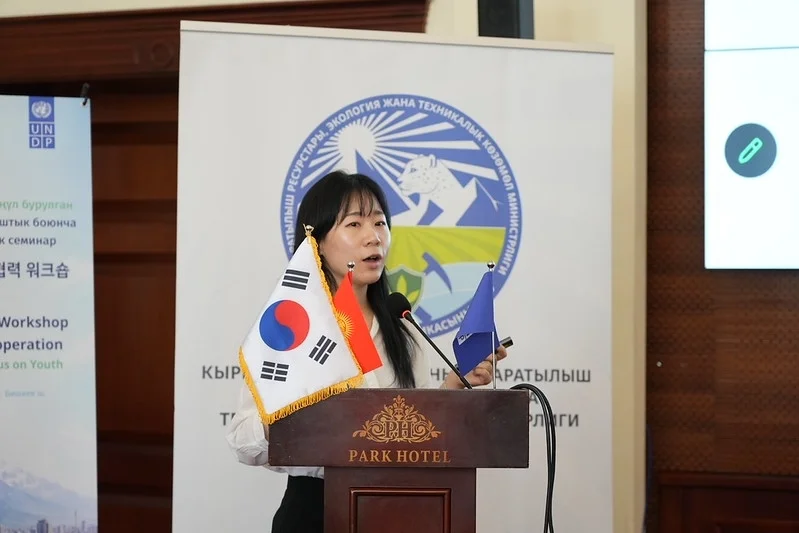
"Framework agreement on cooperation on climate change between Kyrgyzstan and Korea came into force, the parties have formed the institutional basis for its implementation. Now the time has come for concrete steps. In particular, it is necessary to link policy, technology, financing, and projects. The international community is focusing on Nationally Determined Contributions. In this area, Kyrgyz-Korean cooperation should focus on areas such as emissions reduction, forestry, afforestation and reforestation, energy, disaster risk reduction, and ecosystem restoration," said Sophia Lee.
The seminar discussed the relationship between institutional reforms, climate finance, and practical solutions, noting that Kyrgyzstan's climate policy has transitioned from disparate initiatives to a unified state system. Baktygul Ysabekova, Climate Project Coordinator for the United Nations Development Programme (UNDP), spoke about climate actions that deliver practical results for local populations and communities.
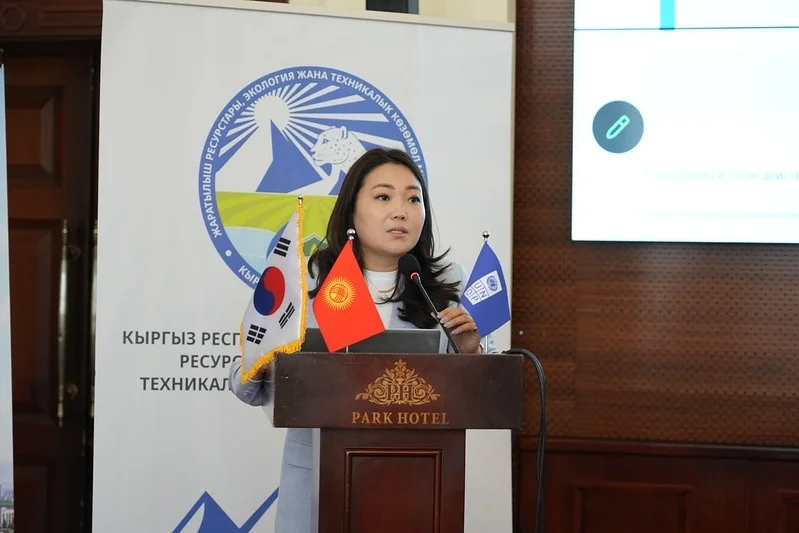
"National agencies, local governments, and international partners completed extensive work to reduce disaster risks and establish early warning networks. Teams actively upgraded hazard monitoring systems, accelerated crisis response times, and conducted rigorous avalanche risk assessments. Specialists continuously monitored glacial lake outburst floods (GLOFs) and enhanced emergency service preparedness.
Across the region, field teams launched localized pilot projects, drafted community risk plans, built water conservation infrastructure, and delivered practical, resilient solutions directly to vulnerable populations.
In the urban sector, Osh City serves as a primary model for climate-resilient infrastructure and water management. Municipal authorities and technical specialists completed a comprehensive climate risk profile for the city and established a dedicated technical working group. To protect urban populations from sudden flash floods, this group successfully deployed a modern early warning network along the Ak-Buura River" stated Baktygul Ysabekova.
It is worth noting that the discussion placed particular emphasis on promoting innovation and youth participation in climate action, as well as identifying opportunities for future development their joint initiatives, including youth climate solutions.