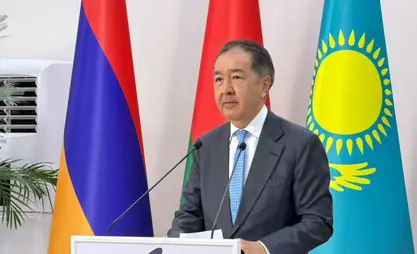
Cholpon-Ata, Aug 7, 2026 ./Kabar/. Eurasian Intergovernmental Council discussed wide range of issues related to the further development of integration within the EAEU at meeting.
According to Bakytzhan Sagintayev, Chairman of the Board of the Eurasian Economic Commission, the discussion focused on trade development, energy markets, tax administration, the digital economy, the formation of a single exchange space, food security, and the climate agenda.
Following the meeting, three important international agreements were signed.
The first is an agreement on electronic commerce of goods within the EAEU. The document aims to protect the rights and economic interests of participants in mutual electronic commerce and define the rules of interaction between them.
The second is an agreement on the admission of brokers and dealers from EAEU member states to participate in organized trading on the exchanges of other countries. The document provides for the mutual recognition of national licenses for brokers and dealers and allows them to directly trade securities and derivative financial instruments on the exchanges of EAEU countries.
As Sagintayev noted, this will increase the liquidity of exchange platforms, expand opportunities for raising capital, and facilitate the development of mutual trade and investment.
The third document is an agreement on the mutual recognition of academic degrees in EAEU member states. It aims to expand opportunities for scientists and teachers to work in other member states and promote cooperation between scientific communities.
Furthermore, the EAEU's economic ties with key trading partners were discussed. According to Sagintayev, free trade agreements with Serbia, Iran, and Mongolia have entered into force over the past year. New agreements have also been signed with the United Arab Emirates and Indonesia.
In particular, the agreement with the UAE will enter into force on October 6, 2026. The ratification process for the agreement with Indonesia is expected to be completed by the end of the year.
The interim trade agreement with Mongolia entered into force on July 22. The document provides for the abolition of customs duties on a wide range of goods and simplified trade conditions.
In the first quarter of 2026, mutual trade turnover between the EAEU countries and Mongolia increased by a third," Sagintayev said.
The EAEU is also continuing negotiations with India and has completed the work of a joint research group with Pakistan. Work is underway to develop cooperation with Jordan, Zimbabwe, and Tunisia.
Bakytzhan Sagintayev added that the common market of countries with which the EAEU has already concluded agreements or is negotiating is home to more than 3.5 billion people, and their combined gross domestic product exceeds $28 trillion.
Another important topic of the meeting was the digitalization of rail freight transportation. Belarus, Kazakhstan, and Russia have transitioned to electronic transport documents. In Armenia and Kyrgyzstan, work continues to create the corresponding legal framework.
Currently, 94% of rail freight shipments between Russia and Belarus and 81% of shipments between Russia and Kazakhstan are carried out using electronic documents.
"The work carried out has made it possible to transport freight between Russia and China without the use of paper documents," he said.
Furthermore, work is underway to improve cooperation between tax authorities of EAEU countries. Expanding the list of goods subject to mandatory traceability is being considered.
This mechanism is planned to come into effect on September 1, 2026. In the first stage, traceability will be extended to household refrigerators and freezers, washing machines, and televisions.
According to Sagintayev, this mechanism will increase the transparency of trade flows, improve competitive conditions, and allow for the confirmation of the legality of goods imported into the EAEU.
Ensuring competition in the EAEU's cross-border markets was also addressed. The Commission presented a report on the state of competition for 2025. A total of 18 applications and appeals were reviewed for violations of competition, abuse of a dominant position, and anticompetitive agreements.
Furthermore, an assessment of the state of competition in 22 product markets was conducted.
Sagintayev also reported that efforts to reduce the cost of mobile services in international roaming are ongoing. Work is underway with telecom operators in EAEU countries to introduce fair tariffs for voice services in roaming by 2028.
According to him, the long-term goal is to bring roaming rates as close as possible to those on a subscriber's home network and significantly reduce call costs.
The next meeting of the Eurasian Intergovernmental Council will be held on October 1-2 in Minsk, he concluded.