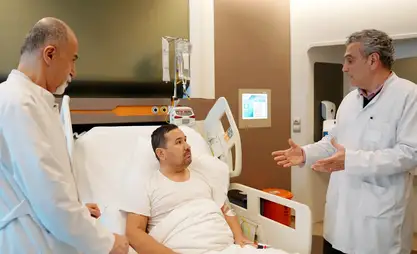
A 39-year-old from Kyrgyzstan, Dayirbek Ergeshov, regained his health after surgeons at Liv Hospital Türkiye removed a tumor from his heart—a malignancy so uncommon that operations of this kind are performed only in exceptional cases worldwide.
From Persistent Cough to Life-Threatening Diagnosis
Living in Kyrgyzstan, Ergeshov sought medical help for a cough that would not subside. Routine chest X-rays revealed an enlarged heart, prompting physicians to order further tests. Echocardiography and MRI confirmed a sizable cardiac tumor, and doctors advised urgent surgery, warning that he might not survive the procedure.
“Before I left for Türkiye my doctor said, ‘You may not make it out of surgery,’” Ergeshov recalls. “I quietly said goodbye to my family. Had I not had that chest X-ray, the tumor would never have been detected.”
After sending his results to several hospitals, Ergeshov received the first positive response from İstanbul. He traveled to Liv Hospital Ulus and, in December last year, underwent open-heart surgery performed by Prof. Dr. Ahmet Özkara and Dr. Halil Hüzmeli, specialists in Cardiovascular Surgery. The complex operation was successful; follow-up imaging now shows the mass has shrunk by roughly 90 percent.
Surgeons Describe a Once-in-Hundreds-of-Thousands Condition
“Malignant heart tumors occur in far fewer than one in 100,000 people, and many cannot be removed because they adhere to the heart’s chambers or outer wall,” explains Prof. Dr. Ahmet Özkara. “Our patient was young—just 39—and his tumor occupied a vast area of the right atrium, even invading the inter-atrial septum. It measured nearly ten centimeters and consisted of several lobes.”
Using cardiopulmonary bypass, the team excised most of the mass. Complete removal of such malignancies is rarely possible; pathology confirmed cancerous tissue, and the remaining portion is now being treated with chemotherapy and targeted (“smart”) drugs.
Without timely intervention, Prof. Özkara notes, the tumor might have closed the tricuspid valve, led to sudden cardiac arrest, or caused irreversible heart failure. “The surgery carried obvious risks—embolism to the brain, stroke, operative mortality—but the patient recovered quickly and his symptoms resolved.”
A Seven-Hour Operation Few Centers Attempt
Dr. Halil Hüzmeli recalls receiving the scans: “We saw an abnormally large mass in an unusual location. As it grew, it began compressing the airway behind the heart, producing cough and shortness of breath. When the right atrium enlarges on chest X-ray, cardiologists must investigate further—that’s what saved him.”
The tumor, roughly 8 × 10 cm, had spread along critical structures. “Open-heart removal took about seven hours. Any slip could damage vessels or halt cardiac function,” Dr. Hüzmeli says. “Left unchecked, the mass would have continued growing, obstructing venous return and ending in right-sided heart failure and death.”
Ergeshov had previously ignored symptoms—palpitations and fatigue—until they flared again. “Neglecting follow-up can allow such hidden, life-threatening problems to advance,” the surgeon warns.
Looking Forward
Ergeshov has returned to İstanbul for routine controls and further oncological therapy. Grateful to be alive, he urges others not to delay medical checks: “I thought the end had come for me. Now I know early diagnosis and expert care can change everything.”
For additional information or media requests, please contact:
FL PR and Communications
Email: asset@flcommunications.co.uk
Phone: +90 (533) 020 25 54