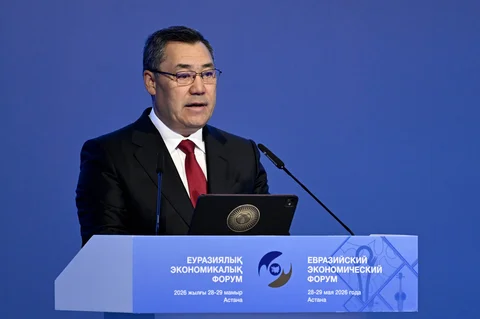
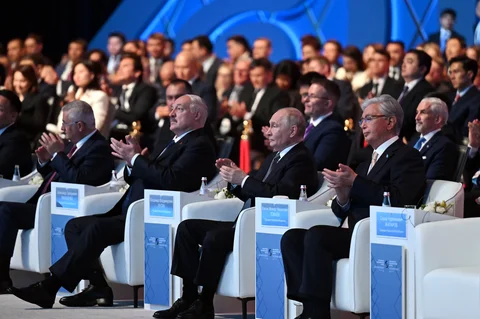
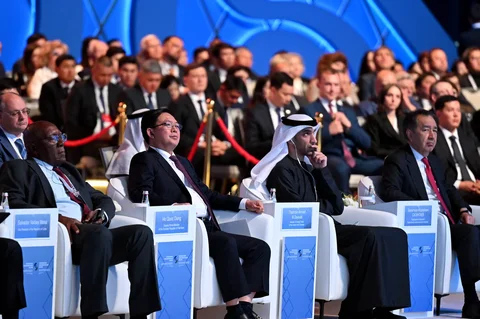
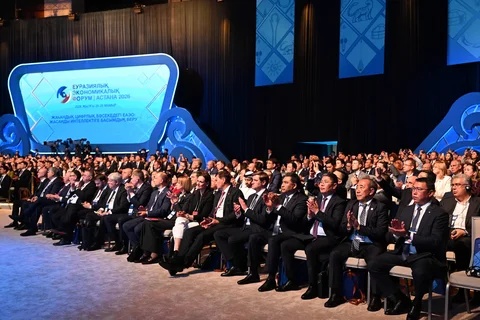

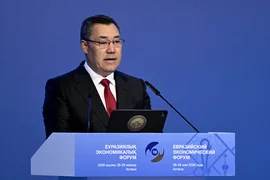
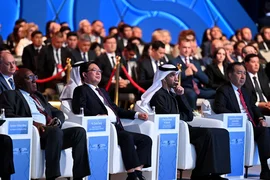
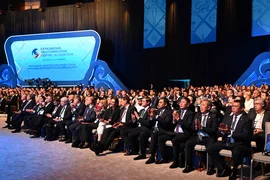

Bishkek, May 29, 2026 /Kabar/. On May 28, Kyrgyz President Sadyr Zhaparov addressed the plenary session of the Eurasian Economic Forum, taking place in Astana.
In his speech, the head of state emphasized that artificial intelligence can become a tool not only for technological but also institutional renewal, contributing to improved public administration.
As the President noted, the forum's theme, "The EAEU in the Global Digital Race: Betting on Artificial Intelligence," today defines the contours of tomorrow for the economies and societies of the participating states.
"Artificial intelligence is no longer just a narrow tool for the IT sector – it is a new reality. As heads of state, we bear daily responsibility for the security, stability, and well-being of millions of our citizens. And today, looking at the rapid development of technology, each of us inevitably faces a fundamental strategic question: how to ensure that this colossal resource strengthens our sovereignty and does not turn our countries into passive consumers of foreign digital technologies and algorithms," emphasized Sadyr Zhaparov.
The president noted that in recent years, Kyrgyzstan has carried out extensive work to create a modern digital ecosystem for the state. The Digital Code of Kyrgyz Republic has entered into force, creating a unified legal framework for the digital environment – from data regulation and digital identification to the implementation of innovative technologies and artificial intelligence.
The head of state also announced the development of the state cloud infrastructure, G-Cloud, and the ongoing modernization of the interdepartmental electronic interaction system, Tunduk, which has become a key platform for digital interaction between the government, businesses, and citizens. Over the past year alone, the number of transactions in the system has increased exponentially, representing millions of man-hours saved and a significant reduction in costs for citizens and entrepreneurs.
Sadyr Zhaparov emphasized that the very philosophy of public administration is changing in the country.
"Several years ago, I set the task of digitalizing public services and administration, and for many, this seemed like a daunting task at the time. Today, Kyrgyz citizens can re-register real estate, obtain a certificate, and process documents via their mobile phone without visiting a single government agency. At first glance, this is a matter of convenience. In reality, this represents a completely different architecture of government transparency," the head of state remarked.
The president noted that Kyrgyzstan is consistently reducing bureaucratic procedures, digitizing processes, and minimizing the human factor, with artificial intelligence becoming a strategic tool for these transformations.
As a specific example, the head of state cited the reform of the driver's license system, which has introduced AI tools to monitor examination processes, eliminating subjective interference.
This directly improves road safety," the president emphasized.
His speech also focused on the implementation of artificial intelligence in the fiscal system.
The head of state then noted the successful implementation of the AI-Kuzet platform in Kyrgyzstan—a next-generation intelligent tax analysis system based on multi-agent artificial intelligence.
The system identifies fraudulent transactions and discrepancies in value and product indicators, analyzes supply chains within Kyrgyzstan, and creates risk-based taxpayer profiles.
"Where months of manual analysis were previously required, an algorithm now works," noted Sadyr Zhaparov.
Similar approaches are being used in customs. Artificial intelligence helps extract data from documents and classify goods according to the nomenclature of foreign economic activity.
The president expressed confidence that artificial intelligence could become one of the most effective tools for ensuring transparency and fairness in government processes.
"Corruption arises where decisions are made in a non-transparent manner, where there is room for subjective discretion. Digital algorithms make processes objective and accountable to society," noted Sadyr Zhaparov.
At the same time, the head of state emphasized the importance of ensuring digital sovereignty.
"Those who don't manage their data don't manage their future. And those who depend on external infrastructure, algorithms, and security systems remain vulnerable. This is why Kyrgyzstan is placing its emphasis on developing national AI solutions," he said.
Sadyr Zhaparov also emphasized the potential for cooperation between the Eurasian Economic Union member states in the field of artificial intelligence.
"Our countries are united by a deep historical commonality, strong scientific traditions, and shared economic interests. By combining our efforts in developing joint models, creating shared computing power and data centers, we can become not just users, but full-fledged architects of the global digital agenda," the head of state emphasized.
The president also noted that Kyrgyzstan is consistently investing in education and implementing reforms in this area.
Today, all schools in the country are connected to high-speed internet, and universities are launching programs in artificial intelligence, digital law, and modern IT. Together with international partners, digital competency centers are being created to train a new generation of specialists.
In conclusion, Sadyr Japarov quoted the outstanding Eastern thinker Zhusup Balasagyn: "Science and reason are the foundation of all endeavors."
"We are living in a historic moment. The changes brought by artificial intelligence are comparable in scale to the Industrial Revolution or the conquest of space. But if back then it was a matter of decades, in today's digital race it's a matter of months. Artificial intelligence is the new locomotive of world history. And the decisions we make will determine whether our countries will find themselves in the cockpit of this locomotive or remain standing on the platform," the president said.
The head of state expressed confidence that the trust, shared experience, and strategic partnership of the EAEU states will enable us to jointly chart a successful path to the digital future.