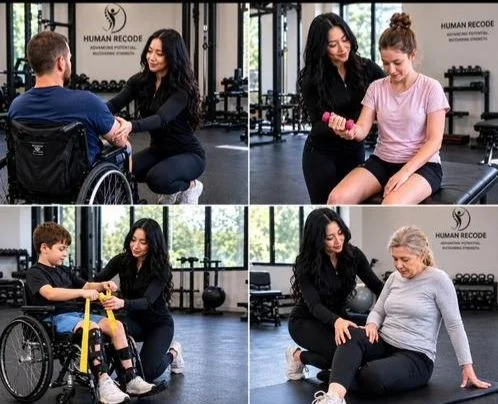
Young Kyrgyzstani specialist Nurkyz Beishenalieva has developed her own method in the field of rehabilitation medicine in the US and is successfully working to restore patients with limited motor function due to stroke and other neurological diseases.
She has now opened a private rehabilitation center. Her original method was published in the international medical journal Cureus and has generated considerable interest in the professional community. She discussed this and other achievements in an exclusive interview with Kabar News Agency.
— Please tell us about yourself. Where are you from and what is your profession?
— I'm from the village of Kabak in the Jeti-Oguz district of the Issyk-Kul region. After graduating from high school, I entered the Ala-Too International University in Bishkek and received a medical degree in English.
Then I enrolled in a master's program at Life University in San Dimas, California, USA, in sports medicine. I graduated with honors last fall. I now live in Atlanta, Georgia.
— You opened a rehabilitation center in the United States. Tell us about its operations and your work.
— After completing my master's, I joined a local company and began working as a post-stroke rehabilitation specialist. During my work, I developed several successful clinical cases.
I particularly remember a patient who had suffered eight strokes and had completely lost mobility. He also had severe vision and hearing problems. He suffered his first stroke in 1997, and he lived in serious condition for almost 30 years. Doctors in Atlanta considered his case hopeless and stopped treating him.
However, using my new rehabilitation method, the patient showed significant improvements within just two months. He began walking independently and was no longer dependent on a wheelchair. Later, he was able to perform everyday tasks independently.
This case gave me great confidence. I realized that even with the long-term consequences of a stroke, properly selected rehabilitation can yield results. After this, I developed my own rehabilitation protocol and decided to open a center.
In my practice, I see that people of any age—even in their 20s—can experience a stroke or other neurological diseases and be left with long-term limited mobility. Now I work with such patients, striving to improve their quality of life.
— Do you have plans to open a similar center in Kyrgyzstan?
— Of course. After I gain experience in this field, expand my client base, and refine methods for maximizing patient recovery, I would like to open a similar center in my home country. As far as I know, there are almost no rehabilitation centers of this format in the country, yet there are many people in need of help.
— We heard that your research was published in a reputable journal, a top publication. Tell us more about this.
— The international medical journal Cureus is one of the most significant scientific platforms in medicine. Publication there requires a high level of research, methodology, and protocols. Each study must be accurate, well-founded, and scientifically validated. Sometimes researchers work on this for years to achieve the required level.
On May 19th, my developed methodology was published in a journal titled:
"Intensive Individualized Rehabilitation for Chronic Post-Stroke Disability: Functional Outcomes, Fatigue Management, and the Importance of Enhanced Neuroplasticity." This was a significant achievement for me and a great motivator for my professional development.
— Your success in America is surely inspiring to many. What advice would you give to Kyrgyz youth looking to find their place in life?
— When I was in school, I never imagined that one day I would go to America and open my own center. My mother raised us alone, and together we went through many difficulties. I slept only two hours a night, while studying and working to pay for my education. This path was not easy, but I never gave up on my goal. Therefore, no matter what area a person is developing in, constant learning and hard work are essential.
I was greatly encouraged by the words of experienced neurologists from prestigious American universities and clinics who supported my method and said, "We'll be your fans."
I grew up in an ordinary village in a middle-income family. If I was able to achieve such results, then others can too. The most important thing is to believe in yourself, work hard, and never give up.