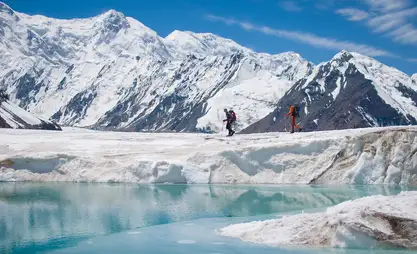
The Cabinet of Ministers has submitted for public discussion a draft resolution on granting the status of specially protected natural areas to glaciers and snow-capped regions of Kyrgyzstan. This document establishes the rules for accounting, monitoring, protection and effective use of glaciers, and aims to develop a unified, systematic approach to their conservation.
Almaz Musaev, Deputy Minister of Natural Resources, Ecology and Technical Supervision told Kabar about the impact of climate change on the country's main natural wealth, glaciers, and the lives of the people, as well as the measures being taken by the state.

— Mr. Musaev, can you tell us about the measures being taken in Kyrgyzstan in connection with climate change?
— First of all, I would like to touch upon the fact that President Sadyr Zhaparov raised the issue of the impact of mountainous regions at UN, resulting the adoption of Five-Year Plan for the Development of Mountainous Regions (2023-2027). A special Roadmap sets the tasks of economic development of mountainous regions, implementation of climate change adaptation measures, and protection of natural ecosystems. For example, these include measures such as growing plants that are suitable for the conditions, introducing water conservation technologies. The relevant ministries and state institutions are working on the basis of this Roadmap. Climate change has shown us that mountains, which used to be rich in water, clean air, comfortable and safe, are the most vulnerable.
Unfortunately, with climate change, mountainous areas are at risk of being exposed to completely different impacts. Glaciers are melting rapidly, and climate disasters and risks are increasing. With climate change, the areas of diseases and insects that were previously confined to warm regions are also changing. This is a big challenge for the health sector. As part of the five-year anniversary of the development of mountain regions, we plan to hold the “Bishkek+25” Global Mountain Summit in 2027 and once again draw the attention of the world.
— What specific projects has Ministry of Natural Resources, Ecology and Technical Supervision introduced ahead of the “Bishkek+25” Mountain Summit, taking into account climate change?
— The development of mountain regions by our country and raising the problems of mountaineers at the global level have given a great impetus to the international community. After the call was issued, international organizations are eager to come and work with projects. This can be said to be Kyrgyzstan’s political determination and focus on specific programs. For example, the FAO is implementing a project to increase forest areas as part of climate change adaptation measures. This large-scale pilot project is being implemented in Ak-Talaa, Toguz-Toro, Uzgen, and Suzak districts in collaboration with local forestry, aiyl okmotu (local administration), and specially protected areas.
In addition, World Bank started projects on clean air in cities. Adaptation Fund project is also being implemented to prevent pasture degradation, transition livestock from quantity to quality, to breed livestock, and improve seed quality.
With climate change, changes are also occurring in wild biodiversity. Wild animal migration routes are changing, and diseases are becoming more prevalent. Projects are underway to preserve the snow leopard and snow leopard ecosystem.
By the way, the global conservation initiative “30x30” was launched, which aims to preserve 30 percent of all land and water resources on the planet by 2030. Kyrgyzstan also accepted the challenge, and today the number of specially protected areas has reached about 13 percent. We are working with partners to reach 30 percent by 2030.
As you know new climate conditions are affecting glaciers. What measures is the ministry taking to protect them?
— Today, in order to protect glaciers, the law “On Specially Protected Natural Areas” was amended, and all glaciers were included in the category of specially protected areas. Also, draft resolution was submitted for public discussion, which provides for all the conditions for how to count glaciers, who will monitor them, and how to protect them.
— Meanwhile, there are cases of wild animals descending from high mountains. What does it mean?
— The situation varies depending on the species of wild animals. First, they are descending in search of food. Second, since the areas around the city have been improved, they may be looking for grazing land. And the number of some species of wild animals has increased. In addition, there are animals are coming down. For example, we can mention the mountain goats in the Chui region. Previously, they inhabited only high-mountainous areas.
— Is this a positive development?
— On the one hand, it is a pleasant sight. On the other hand, with climate change, the habitats of animals are changing. We need to study this situation in depth. Because in some places, anthropogenic impacts may be so strong that wild animals are forced to migrate.
— Thank you for the interview!