
Bishkek, July 15, 2026. /Kabar/. Kyrgyzstan, a mountain nation in the middle of Central Asia, is quietly assembling the pieces of a place where you can work for the world and live beside a lake. A digital-nomad visa, tax-free zones for tech and creative businesses, and a fast-growing IT sector make up the policy side. Issyk-Kul – one of the largest alpine lakes on Earth – could become one of the places where remote professionals choose to live.
First, where is this?
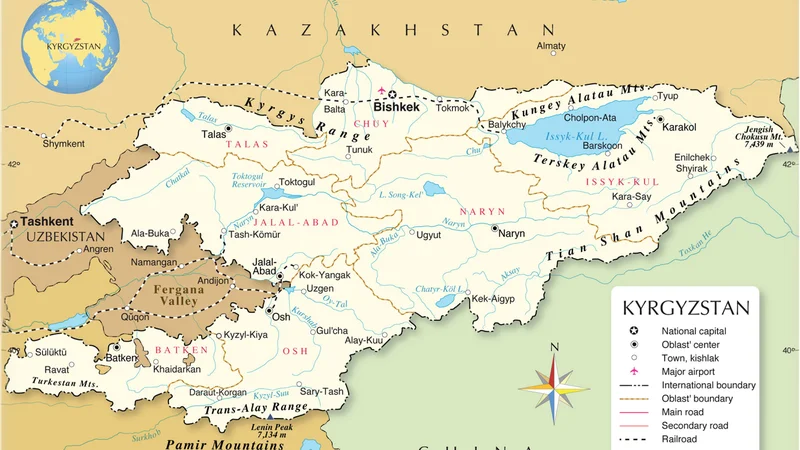
If you've never had a reason to look up Kyrgyzstan, here's the short version. It's a landlocked country in Central Asia, bordered by Kazakhstan, China, Uzbekistan and Tajikistan – small, mountainous, and strikingly green in summer, with more than ninety percent of its territory sitting above 1,500 metres. The capital, Bishkek, is a walkable, tree-lined city of roughly a million people. Two hundred kilometres to the east lies Issyk-Kul, the world's second-largest alpine lake after Lake Titicaca, ringed by the snow peaks of the Tian Shan.
For decades, Issyk-Kul was known mainly as Kyrgyzstan's great summer resort – a place you visited for a few weeks in July and left once the season ended. That's beginning to change. The rise of remote work, the growth of a digital economy, and a set of deliberate government policies aimed at attracting foreign specialists are slowly giving the region a new role: not somewhere you pass through, but somewhere you could stay.
A country assembling an ecosystem, not a single perk
What makes Kyrgyzstan's approach notable is that it isn't built on one incentive – it's several connected mechanisms, all pointing in the same direction.
In 2022 the country launched a pilot "Digital Nomad" status for foreign nationals. It was later written into law, and in May 2025 the Cabinet of Ministers approved the formal procedure for granting it. The status is designed for people working remotely in information technology, software development and related fields. An online application platform went live in December 2025. It's first granted for 60 days, can then be extended for a year, and can be renewed annually for up to ten years in total.
A visa alone, though, doesn't make a country attractive. You also need companies, clients, clear rules for doing business, professional communities, housing, internet and a decent quality of life. And Kyrgyzstan has been building those pieces too.
The central institution is the High Technology Park (HTP) – a special regime for IT companies that serve mainly international markets. Residents pay zero profit tax, zero VAT and zero sales tax, a flat five-percent income tax for employees, and a one-percent contribution on revenue to the park's administration. The regime is written into law with no expiry date, and it's already producing real numbers: in 2025, the combined revenue of HTP residents reached 17.1 billion soms – roughly 195 million US dollars – up 50 percent on the year before.

Alongside it, Kyrgyzstan is building a Creative Industries Park that reaches beyond IT into architecture, design, film, video, advertising, digital marketing, media and education – fields where the product is knowledge and ideas rather than hardware. Together, the two parks widen the door: developers, designers, architects, producers, consultants, marketers, teachers and founders who can all serve clients anywhere in the world.
Why tax breaks are never enough
Countries compete for remote workers with more than visas and tax rates. Someone can register a company in one place, live in another, and work with clients in a dozen more – so when they actually decide where to live, what matters most is safety, cost of living, internet quality, transport, healthcare, schools, climate, and community.
This is where Kyrgyzstan can offer something hard to find in the big, expensive tech hubs: moderate costs, a growing digital economy, an easy-to-navigate business scene, and nature within reach. Bishkek is where the companies, creative spaces, universities and professional networks cluster – it's where deals get done and partners get found. But full-time life in any growing capital comes with the usual downsides: traffic, noise, construction, and poor winter air quality.
This is where Issyk-Kul complements Bishkek rather than competing with it. The capital remains the business centre; the lake becomes the place for longer stays, focused work and genuine rest. In that model, a specialist doesn't have to choose between a career and the outdoors – they keep their ties to the country's professional life while spending much of their time away from the crowded city.
Why Issyk-Kul specifically
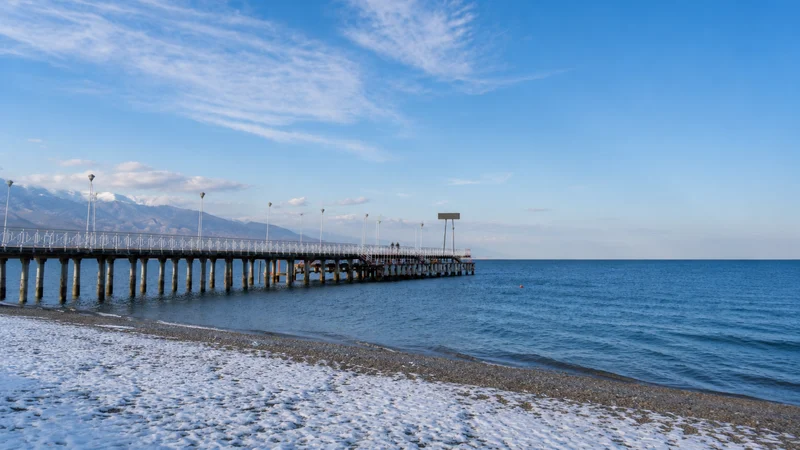
Issyk-Kul sits at about 1,607 metres above sea level, cupped by the Tian Shan ranges. It's slightly saline and almost never freezes over – its name literally means "warm lake" – though the water temperature and climate shift sharply with the seasons.
Its real advantage for a remote worker is simple: it lets you build nature into an ordinary day instead of saving it for a handful of vacation days a year. Screen work usually means sitting still, taking in a constant stream of information, and letting the line between work and life blur. On Issyk-Kul, a working day can be broken up by a walk, a run, a swim, a hike into the mountains, an hour by the water.
And unlike remote wilderness, the region already has the bones of infrastructure: an airport, road links, hotels, guesthouses, restaurants, beaches. The catch is that much of it was built for a short summer season – many places close once summer ends, and existing housing doesn't always offer heating, workspace, reliable utilities, or facilities for families with children. So the next stage for Issyk-Kul isn't just more tourists – it's the shift from a seasonal resort to a place you can spend several months in, or live in year-round.
Two places, one environment
For a foreigner, Kyrgyzstan's appeal may lie exactly in this pairing of two spaces that are different in function but close in geography. Bishkek offers access to business life, professional contacts, universities and government services. Issyk-Kul offers a calmer setting, a natural landscape, and space to live away from the crowding of a city. The northern shore is connected to the capital by road, and Issyk-Kul Airport sits near the village of Tamchy; better transport links would shrink that distance even further.
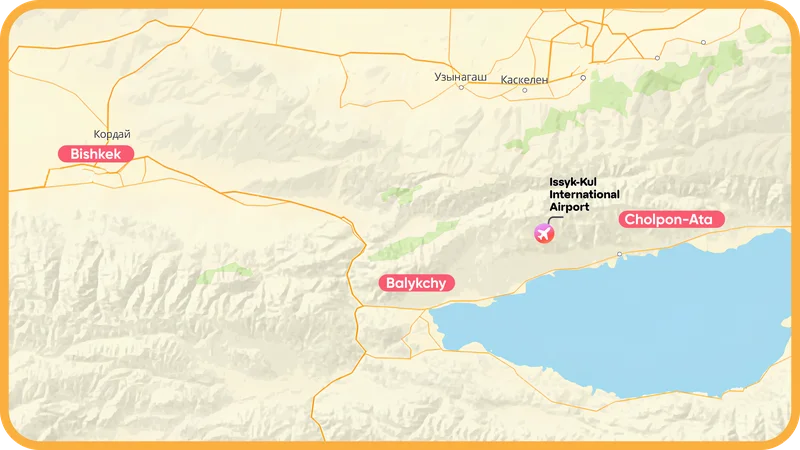
So Issyk-Kul doesn't need to replicate the capital. Its advantage can be something else entirely: to serve as the natural extension of a national digital and creative ecosystem – a place where you work with international clients, collaborate with HTP or Creative Industries Park companies, drive into Bishkek when you need to, and still come home to the lake.
From seasonal tourism to a service economy
In 2025, Kyrgyzstan passed a law creating a special financial and investment territory called "Tamchy," with its own legal regime, in the Issyk-Kul region – aimed at attracting investment and developing financial services, tourism, health resorts, transport and infrastructure. The project is still at the stage of building institutions and rules, so it would be premature to compare Tamchy with established international financial centres. But the choice of location matters: it signals that the state sees the northern and western shores not just as a summer resort, but as a zone for investment and international projects.
Which industries take root here is not a small question. A focus on tourism, recreation, and digital, financial and professional services puts far less strain on the environment than heavy industry would. But a tourism-driven model isn't automatically safe either. Unchecked construction, inadequate sewage treatment, growing waste, traffic and water overuse can damage the lake without a single factory ever being built. The region's real asset isn't waterfront real estate – it's the lake and the ecosystem around it. If that degrades, Issyk-Kul loses its core advantage for tourists, residents and investors alike. Whether the chosen direction pays off depends on whether growth comes paired with working sewage systems, construction controls, protected public access to the shore, and environmental rules that are actually enforced.
What Issyk-Kul still lacks
Turning the lake into a place people can live full-time takes more than extra hotels. A remote worker needs a whole set of everyday conditions: reliable high-speed internet, housing built for cold weather, co-working and meeting spaces, healthcare and everyday services, sports facilities, spaces for children, cafés and shops that stay open outside summer, and a professional and social circle.
Community matters most of all. One of the biggest risks of living outside a major city is professional and social isolation. A place built for remote workers has to offer not just square metres, but an environment where people can meet, collaborate, host events and build things together – and it's the absence of exactly this kind of integrated infrastructure that still limits year-round life on the lake.
One project trying to fill the gap
One project aimed at closing that infrastructure gap is ROYAL ololoAkJol, under construction on the northern shore of Issyk-Kul and developed by ololo group together with Royal Construction. For several years, ololo has run a co-working resort, ololoAkJol, and a family hotel, ololoFamily, on the same site – experience that gave it a close look at what different guests actually need: summer tourists, families, event-goers, and specialists who come to the lake to work and stay a while.
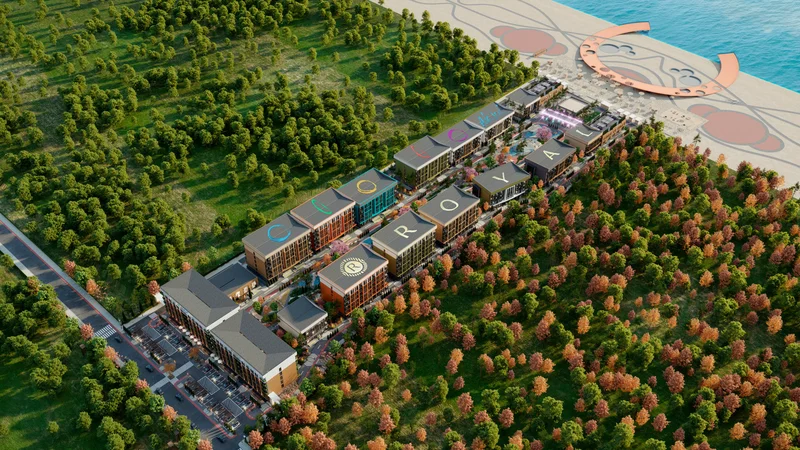
ROYAL ololoAkJol is conceived not just as a resort residential development, but as a year-round environment that brings together housing, work, rest and community. According to the developer, the project includes around a thousand apartments across different formats, access to an existing park of mature trees, and roughly 400 metres of shoreline. Plans – some already up and running – include co-working and workspaces, conference and event venues, fitness and sports facilities, a pool and leisure zones, walking and running trails, children's spaces, a cinema and concert hall, and shared public areas. Apartments range from compact units to family layouts and townhouses, available both fully finished and as White Box (unfinished shell). Construction is scheduled for completion in the fourth quarter of 2027. Buyers should confirm the details of individual units – legal status, purchase terms and timelines – directly against the project and contract documentation.
Its role in the bigger picture goes beyond new housing. The project is building the physical infrastructure for the very model of life Kyrgyzstan is preparing for at the policy level: the HTP and Creative Industries Park create the conditions to work, the digital-nomad status makes it easier to stay, Bishkek supplies the business connections – and ROYAL ololoAkJol is trying to create an environment on Issyk-Kul where people can live and work all year round.
From summer resort to a place to live and work
Issyk-Kul won't turn into an international hub for remote work on scenery, new laws, or a handful of big projects alone. It will take steady progress on transport, internet, healthcare, education, utilities and year-round services – plus transparent rules for investors and real protection of the lake's ecosystem. But the main pieces of the future model are already falling into place: Kyrgyzstan has created a status for digital nomads, is growing an export IT sector through the High Technology Park, supports creative professions through the Creative Industries Park, and is forming a new investment cluster around Tamchy.
What Issyk-Kul adds is something no tax regime or business institution can offer: the chance to live beside water and mountains, spend more time outdoors, and keep a distance from an overcrowded metropolis. If the region grows around quality infrastructure, responsible environmental stewardship and a preserved landscape – rather than maximum construction along the shore – it could take on a genuinely new role in Central Asia. It would remain Kyrgyzstan's great lake. But it could also become a place where international specialists live, work, build companies, and invest in the region's long-term future.
Sources: Kyrgyz Republic Ministry of Justice centralized database (digital-nomad status regulation and procedure); High Technology Park of the Kyrgyz Republic (htp.kg – resident tax regime and 2025 revenue figures); CIS Legislation database (law on the "Tamchy" special financial and investment territory); developer information for Royal ololoAkJol.