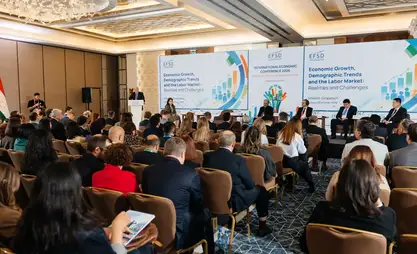

Bishkek, Nov. 3, 2026 /Kabar/. The flagship report by the Eurasian Fund for Stabilization and Development (EFSD), titled "Economic Growth, Demography, and the Labor Market: Realities and Challenges," was presented at an international economic conference in Astana.
Experts emphasize that the demographic shifts (population growth) occurring in Central Asian nations, combined with a reorientation of migration flows, will necessitate the adaptation of these countries' economies to new conditions.
"By 2040, the number of employed people in Kyrgyzstan could rise from 2.7 million to 3.4–3.7 million; to accommodate this, the economy will need to generate between 700,000 and 1 million new jobs," the EFSD report states.
Kyrgyzstan leads the region in terms of economic growth. According to the study, the country’s GDP grew by an average of 10.2% annually between 2022 and 2025. This growth is bolstered by major infrastructure projects, including the Kambar-Ata-1 Hydropower Plant and the China–Kyrgyzstan–Uzbekistan railway. The poverty rate has fallen from 34% to 24%, and real wages have increased 2.2-fold. By 2040, the working-age population is projected to grow by 1.19 million, creating an opportunity for a "demographic dividend."
Experts note that economic transformations will be essential to further developing human potential. These measures could be aimed at supporting the private sector. In other words, expanding formal employment should serve as a factor that bolsters economic growth.
As the report notes, many of the findings are relevant to all four countries covered by the study (Kyrgyzstan, Kazakhstan, Tajikistan, and Uzbekistan).
Among the approaches that could help better harness demographic potential, the report highlights programs that encourage the expansion of private businesses and the creation of new companies.
It also emphasizes the importance of investing in the education and vocational training of young people, as well as providing employment assistance to migrants returning to their home countries.