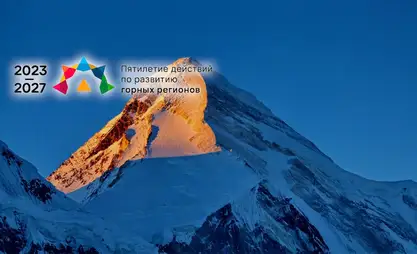
Bishkek has begun preparations for the second Global Mountain Summit, which will be held in the capital of Kyrgyzstan in October 2027. Adaptation to the changing living conditions caused by rising global temperatures will be a key focus of the agenda.
According to international climate institutions, while the average global temperature has increased by 1.3 to 1.5 degrees Celsius over the past 50 years, warming in mountainous regions has been occurring at nearly twice that rate. Scientists note that this process has accelerated in recent decades. Rapid temperature increases are a major driver of glacier degradation, natural disasters, severe storms, as well as heat waves and droughts.
For more than 20 years, Kyrgyzstan has been promoting climate risk mitigation and adaptation initiatives at international platforms, primarily within the framework of the United Nations. At Kyrgyzstan’s initiative, the UN General Assembly proclaimed the Five Years of Action for the Development of Mountain Regions in 2022. The upcoming global summit in Bishkek, to be held at the level of heads of state, will review interim results and launch a new phase of programs and projects aimed at addressing the impacts of climate change.
Speaking at an international meeting, President Sadyr Zhaparov outlined the consequences of global warming for Kyrgyzstan and the risks it may pose in the future. Over the past several decades, the country has lost approximately 20 percent of its glaciers previously classified as permanent. Current melting rates indicate that by 2040 Kyrgyzstan could lose up to 40 percent of its water resources, and by the end of the century up to 80 percent.
Kyrgyzstan warns that the loss of glaciers in mountainous countries would have far-reaching consequences, potentially affecting water security across vast continental regions. The country is therefore calling on the international community to intensify collective efforts before the process becomes irreversible.
Adaptation to new conditions must go hand in hand with preserving economic potential. Mountainous states need to introduce advanced solutions in green energy, as well as improve and modernize hydraulic infrastructure and irrigation networks. These are priority measures required for the rational use of transboundary river resources. Water conservation must begin now to ensure that, even as river flows decrease, sufficient supplies remain for domestic needs, livestock breeding and agricultural development. Experts note that preserving ecosystems in mountain regions is both a challenge and a matter of sustainable development for all humanity.
As experts emphasize, mitigating climate risks and ensuring economic stability are closely interconnected. Large-scale projects require substantial financial resources; therefore, by supporting mountain countries, the international community is also investing in its own future.
Doctor of Economics Tolonbek Abdyrov stresses that mountain climates are inherently unpredictable, and under conditions of global warming they become an even greater risk factor.
“Only about 5 percent of our territory is suitable for agriculture. However, due to geological and climatic anomalies, a significant share of crops can be lost. Mountain ecosystems are highly unpredictable.
The rivers that originate in our mountains flow far beyond our borders, and the entire region depends on them. Therefore, our partners should also invest in glacier preservation projects and in the introduction of water-saving and efficient water management technologies. The state of the economy and food security depends directly on this — not only in Kyrgyzstan or Tajikistan, but across other countries in the region.
We must advocate for the creation of support funds for mountain countries. We should propose concessional financing for the construction of hydropower plants and mountain infrastructure. And perhaps the time has come to recognize ecosystem services as an economic asset.”
Water and glaciers are subjects of international settlements, while service provision and sustainability are matters of contractual obligations. The second Global Mountain Summit in Bishkek is a platform for negotiations where financing for climate programs is directly linked to global development as a whole,” Tolonbek Adyrov said.
In other words, in mountain countries where climate change is occurring at an accelerated pace, action must be coordinated and timely. Investment in these territories should be prioritized, as natural conditions are such that states where 90 percent or more of the territory consists of mountain ranges cannot, by definition, be highly affluent. They simply lack sufficient resources to implement large-scale glacier preservation or climate adaptation projects independently.
Therefore, if the construction of thermal power plants in the region is deemed undesirable in order to reduce anthropogenic impact, viable alternatives must be offered. If requirements are introduced to reduce industrial emissions, there should also be compensation mechanisms for limiting production capacity. If there is a shared objective to preserve glaciers and transboundary river resources, then the responsibility for achieving it must also be shared.
Ecologist Baktybek Saipbaev emphasizes that all types of activities in mountainous regions entail high costs. Due to climatic conditions, agriculture is inherently risky. The terrain complicates logistics, construction requires special standards and compliance measures, and mineral extraction involves additional financial burdens. In other words, any economic activity in mountain areas—particularly large industrial projects—inevitably entails increased expenditures.
Therefore, as the analyst stresses, representatives of the international community must participate in addressing global challenges such as climate change mitigation.
“Coordinated efforts are necessary to maintain environmental stability. Mountain ecosystems are extremely vulnerable and highly susceptible to negative external impacts. We see this in the rapid degradation of glaciers.
We are talking about large-scale environmental protection measures, restrictions imposed on industries, and stricter compliance requirements to reduce emissions—all of which require funding. Naturally, the first countries that should demonstrate concern for mountain regions are those that benefit from our water resources. If we lose our glaciers, living conditions across vast territories will change dramatically. No one wants our region to turn into an arid desert,” Saipbaev said.
The Government of Kyrgyzstan is already systematically preparing for the second Global Mountain Summit under the auspices of the United Nations. At a meeting of the organizing committee chaired by the head of the Cabinet of Ministers, it was noted that several important initiatives have been implemented during the Five Years of Action for the Development of Mountain Regions.
Active development of renewable energy potential has begun, including the construction of dozens of hydropower plants. Under the national “Jashyl Muras” program, up to 8 million trees are planted annually, forming large forest areas that absorb carbon emissions. At the summit, Kyrgyzstan will present additional concrete results of its efforts to address climate change. At the same time, experts emphasize that to reverse current trends, support projects for mountain regions must be scaled up and implemented without delay.