The Toktogul Hydroelectric Power Plant's power generation in winter is a matter of sustainability and reliability for the entire Central Asian energy system. This large hydroelectric power plant (HPP) is a key hub. After a major modernization, its capacity has been increased and its service life extended by several decades.
Experts also point to that is crucial for future regional development. During the cold season, a significant portion of the Toktogul Reservoir is depleted, with all runoff flowing to Uzbekistan and Kazakhstan, where the topography prevents significant water storage. Therefore, in the spring, the water evaporates and disappears into the ground. Thus, by April, the Toktogul reservoir is noticeably empty. In summer, obviously it should provide irrigation for agricultural lands both in Kyrgyzstan and neighboring countries, while also accumulating water for the next period of increased demand and the heating season.
With rising electricity consumption in Central Asian countries and increased industrial production, coupled with projected climate change, the Toktogul HPP and its reservoir are increasingly struggling to maintain their water and energy balance. This is entirely understandable, given that regional economies are growing, requiring increasing amounts of both energy and water for stable development. Experts emphasize that the solution to this situation lies in the rapid construction of large Kambarata-1 HPP with a sufficiently large reservoir, located in the upper reaches of the Naryn River. This cascade will balance water consumption in Central Asia and provide the region with clean energy for development.
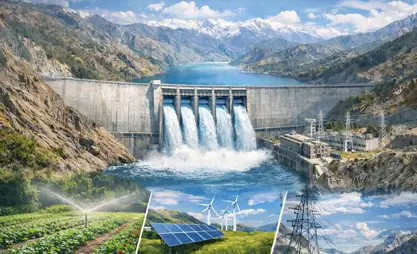
Thus, in winter, the Kambarata-1 and Kambarata-2 plants will bear the load, and the water they produce will accumulate in the Toktogul basin. In summer, the Toktogul HPP will generate energy, simultaneously irrigating agricultural land in three countries. This arrangement ensures regional sustainability. While Kyrgyzstan is currently constructing large station at its own expense, Kazakhstan and Uzbekistan are expected to join the project soon. A trilateral consortium established for this purpose is finalizing a feasibility study with international donors.
Experts insist that the construction of Kambarata-1 cannot be delayed: a changing climate is dictating its own conditions, glaciers are melting, and water runoff from the mountains will decrease over time. Therefore, it is essential to lay the groundwork for the future now. The issue must be raised at various international forums, the capabilities of various intergovernmental associations must be utilized, and opportunities to attract resources from climate funds must be explored. To expedite the project, diplomatic efforts are needed within the framework of the Global Mountain Dialogue initiated by Kyrgyzstan. This will allow the country to receive multiple investment options. According to representatives of the expert community, by the time of the Global Mountain Summit, which will be held in Bishkek in the fall of 2027, Kyrgyzstan should have a roadmap and a completed, agreed-upon project with a formed investment portfolio for all stages of construction and launch.
In this context, the Eurasian Fund for Stabilization and Development (EFSD) recently released report. Analysts analyze the threats posed by global warming to the Central Asian region:
"Kyrgyzstan and Central Asian countries face severe energy shortages in winter, when demand surges. This often leads to costly imports of polluting fuels and threatens energy security. The demand in the region projected to double by 2050, Central Asian countries urgently need affordable, reliable, and sustainable electricity to improve quality of life and support economic growth."
Water is crucial for Central Asia. The region is projected to face an extremely high risk of water shortages by 2040, necessitating close cross-border cooperation. By generating electricity in winter, Kambarata-1 offers the potential to improve water management in the region, reduce flood risks, and protect the existing hydropower cascade on Naryn River,” the report states.
EFSD analysts note strong interest among development partners in co-financing the Kambarata-1 project, thus, Donor Coordination Committee established in June 2024.
The project entails the construction of a new 261-meter-high concrete dam on Naryn River. It will be located upstream of the existing cascade, which includes the Kambarata-2 HPP, the Toktogul reservoir, and other downstream hydropower plants.
Kambarata-1 is a flagship hydropower project. The plant will generate approximately 6,000 GWh of electricity per year, equivalent to approximately 40% of Kyrgyzstan's current output. Firstly, this will ensure the country's long-term energy security.
Secondly, this initiative will help meet the growing energy demand in Central Asia and improve the use of water resources in the region.