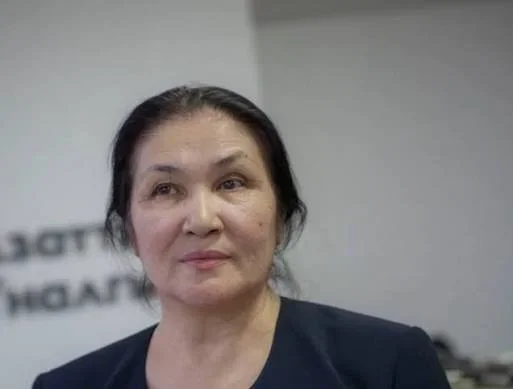
Kyrgyzstan's active engagement within the SCO and its upcoming historic mission at the UN Security Council have elevated the country's international responsibility to a new level. In this context, not just the strength of the authorities but the quality of state institutions takes center stage. Baktygul Kalambekova, a diplomat, former Ambassador of Kyrgyzstan to the United Kingdom of Great Britain and Northern Ireland, and candidate of economics shared this perspective in her interview with Kabar.
The ambassador noted that contemporary foreign policy and domestic reform cannot be viewed as separate processes. She also characterized the last five or six years as a period of reconfiguration for Kyrgyzstan's state institutions.
Emphasizing that it is incorrect to view this period solely through the lens of political changes, she described the current era as a time when the state is re-evaluating its governance model, economic policy, foreign relations, and the relationship between society and the state.
- Dear Baktygul, we recognize that in this era of globalization, Kyrgyzstan must operate in close alignment with international norms. How does Kyrgyzstan’s upcoming UN Security Council membership, alongside its roles in the SCO and EAEU, drive its domestic reforms?
— In my view, the key challenge for Kyrgyzstan today is not merely to increase the number of international organizations in which it participates, but to transform that participation into a resource for enhancing the quality of the state's domestic institutions.
Kyrgyzstan’s election as a non-permanent member of the UN Security Council for the 2027–2028 term marks a significant milestone in the country’s diplomatic history. This will be Kyrgyzstan’s first time serving on the Security Council. Consequently, starting in 2027, the country will participate at a much higher level in discussions and decision-making processes regarding international security issues.
Such a status imposes new demands not only on the state’s foreign policy but also on the quality of domestic public administration. First and foremost, it is essential to strengthen and develop the professional diplomatic and analytical capabilities of our personnel. Secondly, high-quality state expertise is required in areas such as international law, security, the economy, energy, climate, water resources, and technological development. Thirdly, a mechanism must be in place to effectively incorporate assumed international obligations into domestic legislation and state policy.
Kyrgyzstan’s chairmanship of the SCO for 2025–2026 highlighted these very requirements. At the SCO summit held in Bishkek on September 1, 2026, the results of Kyrgyzstan’s chairmanship were highly praised, and its contribution to strengthening the organization’s institutional capacity and practical cooperation was acknowledged.
As for the EAEU, it primarily demands economic and institutional preparedness from Kyrgyzstan. Within the framework of integration, the operations of national institutions, spanning customs, taxation, technical regulation, transport logistics, digital systems, the labor market, and the competitive environment must align with the unified integration space.
For instance, it was officially recorded that in 2025, Kyrgyzstan’s mutual trade with EAEU member states reached $5.9 billion.
Therefore, foreign policy and domestic reform cannot be viewed as two separate processes. The consistency of a state's activity on the international stage is directly linked to how professionally, legally, and effectively its domestic institutions operate. In other words, international standing is reinforced by the quality of domestic institutions.
— Over the past five or six years, Kyrgyzstan has undergone major institutional changes, including constitutional revisions and the strengthening of the vertical power structure. Do these changes demonstrate enhanced operational capacity? To what degree has alignment with these global bodies optimized government agility and strategic decision-making in Kyrgyzstan?
— It is important here to distinguish between agility and the quality of decisions.
The constitution adopted in 2021 redefined the structure of state power and strengthened the role of the presidency. In the years that followed, a series of reforms were implemented to streamline the public administration structure, reduce bureaucracy, and accelerate decision-making mechanisms.
As a result, the state system's decision-making capacity has significantly improved, particularly regarding vertical governance and the mobilization of resources toward a unified goal. For instance, in 2025, additional measures were adopted to enhance the efficiency of the civil service system and eliminate bureaucracy. That same year, amendments were made to the mechanisms for training a new generation of personnel for state and municipal service. By the end of 2025, reforms aimed at improving public administration efficiency and reducing bureaucracy continue.
Thus, there are grounds to say that there have been changes in the operational efficiency of the state apparatus.
The second issue here concerns the quality of decisions and the stability of institutions. For high-quality public administration, factors such as a decision's soundness, expert review, legality, implementation, consideration of public interests, and long-term impact are crucial.
Therefore, while a model of "operational governance" has become quite evident in Kyrgyzstan today, I believe the next stage requires complementing it with a model of a professionally competent and institutionally stable state.
In other words, if the first stage required restoring the state's capacity to make decisions, the next stage involves transforming that capacity into institutional quality.
In this context, while the strengthening of the vertical of power facilitates the coordination of decisions, it simultaneously underscores the need to develop mechanisms that ensure checks and balances, the quality of decisions, and the ability of state institutions to conduct independent professional expert assessments.
— How do you assess the changes that have been taking place in Kyrgyzstan over the past five years?
— I would call it as a period of reconfiguration for Kyrgyzstan’s state institutions. It would be incorrect to view this period solely through the lens of political change. It is a time when the state is rethinking its governance model, economic policy, foreign relations, and the relationship between society and the state.
The 2021 Constitution established the legal foundation for a new governance model. Subsequently, institutional changes continued in areas such as optimizing public administration, reducing bureaucracy, improving the quality of public service, and reforming tax and customs administration. For instance, the structure of tax and customs administration was reorganized in 2025.
At the same time, Kyrgyzstan has become more active on the international stage. Holding the SCO chairmanship for 2025–2026 and being elected to the UN Security Council for 2027–2028 have elevated the country's level of international responsibility.
I view these changes not as a completed reform, but as the shaping of a new stage in the state's development. For transforming state institutions is one stage, whereas establishing a culture of their stable operation is a far more prolonged process.
Kyrgyzstan has enhanced the speed of state decision-making and the capacity to mobilize state resources. The next task is to transform this potential into high-quality institutions, strengthen the professional civil service, reinforce the rule of law, boost analytical and expert capabilities, and ensure the continuity of state policy.
Therefore, to summarize the main outcome of the past five years in a single sentence: Kyrgyzstan is transitioning from the stage of creating a new model of public administration to the stage of strengthening its institutional quality.
The key benchmark for the period ahead will not merely be the strength of state power, but rather the quality, professionalism, lawfulness, and operational stability of state institutions.
This is particularly important, as Kyrgyzstan must now integrate domestic reforms and external obligations into a unified system. Participation in the UN Security Council for the 2027–2028 term, active engagement within the SCO, and integration processes in the EAEU demand precisely this level of institutional quality from the state.
— Thank you for the interview!