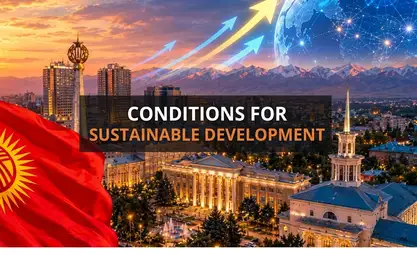
Recent years have clearly demonstrated that political stability and peace serve as a solid foundation and guarantee for the country's establishment, development, and the improvement of socio-economic life. The domestic economy is showing growth of at least 10%, providing momentum for forward progress. President Sadyr Zhaparov constantly reminds that given peace, unity, and harmony, our economy will continue to grow. Public figures and experts monitoring current state affairs unanimously emphasize that this is not merely a standard political slogan, but a fundamental condition for development.
It is evident that Kyrgyzstan's future development trajectory is linked to major ongoing economic projects, the influx of investment, the geopolitical situation, and government plans. In turn, political stability, peace, and national unity guarantee the achievement of established goals. Over the past five to six years, stability in Kyrgyzstan has fostered economic growth, the formation of a new public administration model, and systemic changes. Looking back at the history since independence, political instability often forced the country to start over from scratch; consequently, conditions were lacking for major reforms or the implementation of significant economic and investment projects. The economy frequently regressed, and regaining investor confidence proved difficult. The expert community emphasizes that this must be regarded as a crucial lesson from recent history.
Consider the period since 2020: Kyrgyzstan’s budget has grown nearly fivefold. While the consolidated budget stood at approximately 300 billion soms in 2020, it reached 1.101 trillion soms in 2025.
Economic growth: total GDP stood at $8.3 billion in 2020 and exceeded $22.6 billion in 2025.
Improved tax administration: Tax Service revenues rose from 78 billion soms in 2020 to 304.3 billion soms in 2025.
Customs revenues increased sixfold: collections rose from 28.9 billion soms in 2020 to 157.4 billion soms in 2025.
Non-tax revenues increased eight- to ninefold: receipts rose from 33 billion soms in 2020 to 189.4 billion soms in 2025.
Economic activity increased: the services sector's contribution to GDP exceeded 1 trillion soms, representing a growth rate of 10.9%.
Budget payments from Kumtor increased: between 2021 and 2025, following the transfer of Kumtor to state management, total production revenue exceeded $5.115 billion (over 400 billion soms). Payments to the budget in the form of taxes and other fees totaled $1.176 billion (100.6 billion soms), while an additional $441 million (38.2 billion soms) was collected in dividends.
Under the plan for 2026, the consolidated budget is also projected to exceed 1 trillion soms. Approved revenues stand at 551.2 billion soms, with expenditures at 550.8 billion soms; a surplus of 436.4 million soms is projected. The surplus is projected to reach 40 billion soms in 2027 and 51 billion soms in 2028.
Looking at the next four to five years, GDP is expected to reach $30 billion, with annual economic growth maintained at a minimum of 8%.
Kyrgyzstan ended 2025 with a GDP of $22.6 billion, and per capita GDP exceeded $3,000. The goal is now to raise this figure to $4,000–$4,500 by 2030. Additionally, plans are in place to increase the share of small and medium-sized enterprises (SMEs) to 50% of the economy; notably, this sector’s share of GDP already exceeded 51% in 2025.
Behind these figures lie tangible achievements: industrial and social facilities, roads, wages, pensions, social benefits, and new jobs, all of which are currently visible and under discussion. These are just a few of the changes currently underway. The task ahead is to maintain this momentum.
Particularly, in era of globalization and intensifying international competition, the key prerequisites for transforming Kyrgyzstan into a modern, powerful state are domestic peace and stability, as well as the unification of society around a common goal. In recent years, a broad path toward development has opened up for the country, a fact confirmed by the policies pursued by the head of state.
Kyrgyzstan’s economic development directly impacts the life of the state and every individual citizen. Sheradil Baktygulov, political scientist and governance expert analyzed the projected outcomes achievable through social harmony and stability, categorizing them into several key areas.
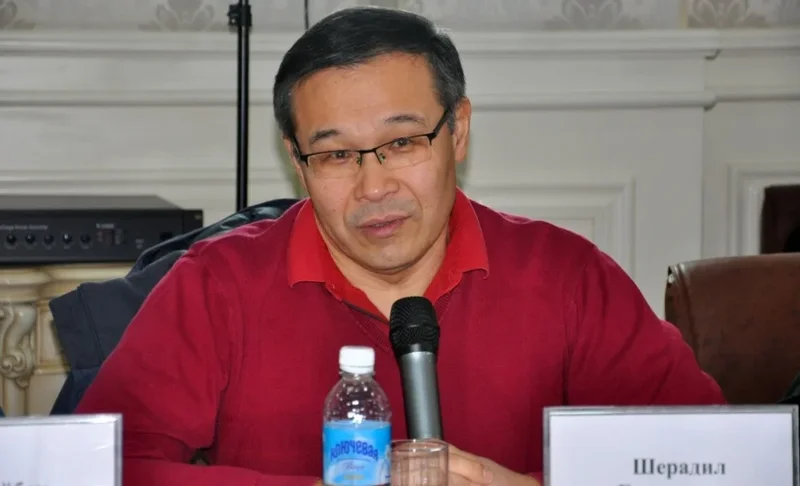
"Economic stability means the opening of new enterprises, logistics centers, and manufacturing facilities." This creates conditions enabling our compatriots currently working as migrants in Russia, Europe, Turkiye, and other countries to work in their homeland.
GDP grows, tax revenues increase, and the state budget is replenished. This, in turn paves the way for the repayment of external debt and financial independence. Thanks to the country's political and legal stability, major foreign investors are confidently bringing in capital to finance large-scale projects, including the construction of roads, factories, and hydroelectric power plants.
The second area of focus is the improvement of the social sector. To cite just one example: the salaries of civil servants, law enforcement officers, teachers, and doctors have been raised. Schools and hospitals are being equipped with modern technology, while the quality of education and healthcare is approaching international standards. Clean drinking water is reaching villages and settlements, and roads are gradually being repaired. Reliable electricity and internet access are also improving.
The third area concerns the environment and the "green" economy. Kyrgyzstan has taken steps to fully harness its hydropower potential and hydroelectric plants, aiming to become a major hub for the production and export of clean energy to neighboring countries. Special attention is being paid to the preservation of glaciers and nature, as well as to environmental safety.
The fourth area involves political stability and the rule of law. As we achieve sustainable development, government services are being digitized, and corrupt practices are gradually being eliminated. A society based on the rule of law, where everyone is equal before the law is taking shape. Political stability has put an end to the frequent upheavals the country once experienced, creating the conditions necessary for long-term planning and the implementation of state programs.
The fifth area relates to our standing on the international stage and the development of tourism. It is no secret that, thanks to its stunning natural beauty, including Issyk-Kul Lake and its majestic mountains, Kyrgyzstan is becoming one of the safest and most popular destinations for travelers from around the world. "Regarding its geopolitical significance, the country’s role as a transit hub for Central Asia is growing; thanks to major projects like the China-Kyrgyzstan-Uzbekistan railway, it is becoming a key player in global trade.
In short, sustainable development means transforming Kyrgyzstan from a recipient nation into an economically strong, developed state where the safety and well-being of citizens are fully guaranteed," said Sheradil Baktygulov.
The expert noted that these objectives are enshrined in the development strategy known as "New Kyrgyzstan."
In his view, if Kyrgyzstan operates in an environment of stability and harmony, it will achieve its goal. After all, the country has managed to improve its performance indicators over the last six years alone. This demonstrates that the potential exists and that progress is achievable.