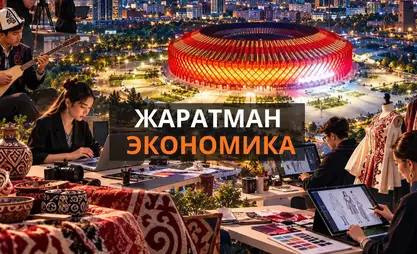
Today, a new economic sector based on human capital, talent and intellectual potential is taking shape in Kyrgyzstan. The country views the creative economy as a key strategic direction for reducing its dependence on the mining industry and remittances from migrant workers. The next goal is to transform creative industries into a sustainable sector that accounts for a significant share of the country's GDP. Meanwhile, international experts have recognized Kyrgyzstan's experience as a model worthy of study and adoption by other countries.
To ensure economic growth, Kyrgyzstan is increasingly focusing not only on the production of material goods but also on ideas, innovation and intellectual capital. In recent years, the creative economy has emerged as one of the most promising sectors, contributing to higher household incomes, job creation, increased exports and the development of innovative entrepreneurship.
Unlike traditional industries producing physical goods, creative industries are not significantly constrained by Kyrgyzstan's relatively small domestic market or its landlocked geographical position.
A Turning Point: 2020–2026
The past five years have marked a major turning point in the development of Kyrgyzstan's creative economy.
According to estimates from 2022, nearly 50 percent of creative businesses operated in the informal sector, while the creative economy accounted for only around 1 percent of the country's GDP.
To address this situation, the government took a forward-looking approach by recognizing intellectual property and talent as key forms of capital.
In April 2022, President Sadyr Zhaparov issued a decree, and the Cabinet of Ministers approved the Concept for the Development of the Creative Economy for 2022–2026. The document aims to promote the sector's development and strengthen its export potential.
"In the future, the creative economy will stimulate innovation, enhance investment attractiveness, reduce the national economy's dependence on the mining industry and remittances from migrant workers, and contribute to the revival of cultural heritage and the preservation of national identity in the context of globalization," the concept states.
That same year, Kyrgyzstan became one of the first countries in the world to adopt a Law on the Creative Industries Park.
This legislation is considered unique in international practice, as it establishes a special regime offering tax and social benefits to professionals working in more than 15 creative fields, including architecture, design, media, music and cinema.
The Creative Industries Park was also established and has become known as the first professional association of its kind in Central Asia.
In 2026, President Sadyr Zhaparov signed another decree, "On Measures to Improve the Taxation and Tax Administration System."
Under the decree, professionals working in information technology, artificial intelligence, application development, blogging, remote services for foreign companies, startups, film production, video production, television and other creative fields were granted tax exemptions for a five-year period.
Although these exemptions may temporarily reduce direct tax revenues, they are expected to encourage thousands of people earning income in the creative sector to formalize their activities and contribute to the national economy through other payments and economic activity.
Success Stories of Kyrgyzstan's Creative Economy
As a result of these developments, the national brand "Zharatman Kyrgyzstan" (Creative Kyrgyzstan) has emerged, creating opportunities to retain young talent, generate new jobs and strengthen the country's export potential.
Kyrgyzstan's creative sector now includes rapidly developing digital products in information and communication technologies, computer software, mobile applications, video games and other innovative solutions.
The creative economy also brings together professionals working in science and technology, culture, architecture, design, art, music and entertainment, as well as specialists in business, commerce, finance, law and healthcare.
For example, Kyrgyzstan's domestic film industry has achieved international recognition, while animation, YouTube projects, contemporary design and digital art are increasingly entering global markets.
Meanwhile, the Bishkek Arena stadium, designed to accommodate more than 50,000 spectators, has demonstrated its potential as a major infrastructure facility for the development of the country's creative economy, cultural industries and tourism.
Major international entertainment events have shown that the global show business industry can generate millions of dollars in revenue.
International visitors use transportation, hotels, restaurants, logistics services, handicrafts and food services, creating new jobs in creative and related industries while increasing business revenues.
Moreover, multimedia technologies, lighting shows and sound equipment used at the stadium provide opportunities for domestic creative studios, programmers and digital content producers to gain experience and eventually export their services.
The Ministry of Economy and Commerce recently informed the Kabar News Agency that Kyrgyzstan's model for developing creative industries had been recognized as unique and worthy of adoption by other countries at the Fifth World Conference on Creative Economy, held in Jakarta, Indonesia.
According to the ministry, Martin Smith, a researcher specializing in cultural and creative industries at Goldsmiths, University of London, highly praised Kyrgyzstan's experience.
The expert drew attention to Kyrgyzstan's geographical position as a landlocked country located far from the world's oceans.
He noted that just six years ago, he could hardly have imagined that a country like Kyrgyzstan would seriously embark on developing its creative economy and establish its own innovative model for stimulating the sector.
Today, however, he considers Kyrgyzstan's Creative Industries Park a remarkable example of how fiscal instruments can contribute to the development of an entire economic sector.
Smith particularly emphasized that this experience deserves to be studied and adopted by other countries.
"Kyrgyzstan has become the first country in the world to introduce a special preferential tax regime covering all areas of the creative industries. The Creative Industries Park represents an entirely new model based on tax preferences, virtual residency and the absence of geographical restrictions," the Ministry of Economy and Commerce stated.
Although Kyrgyzstan has not yet reached the level of global content production giants such as Hollywood in the United States or Bollywood in India, the country is taking its first steps onto the international stage by developing original content rooted in its national cultural identity and through the activities of the Creative Industries Park.
Economist Iskender Sharsheev shared this assessment, noting that the unique combination of government support and a dedicated legislative framework has attracted growing international interest.
"Kyrgyzstan's experience in creative industries is considered distinctive and unique in terms of its content. This is largely because Kyrgyz culture is rich in unique traditions and characteristics.
"At the same time, we are only beginning to establish ourselves on the global stage. For example, there are still areas where our creative industries need further development. We have not yet reached the level of Hollywood or India's Bollywood. Therefore, we cannot claim to be global leaders in content production or other areas of the creative economy.
"Nevertheless, the government is providing substantial support to the sector. A legislative framework has been established, and members of the Creative Industries Park benefit from preferential tax rates of just 1–2 percent.
"In terms of incentives for creative industries, Kyrgyzstan has taken a leading position. Our model is now being studied internationally. Compared with many other countries, Kyrgyzstan has developed and introduced one of the world's first models of its kind," economist Iskender Sharsheev said.