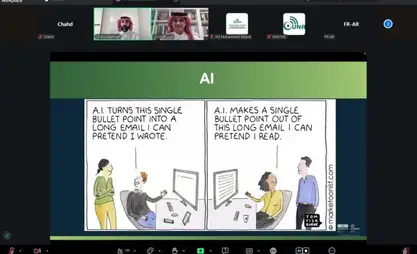
The Union of OIC News Agencies (UNA) organized today, Wednesday, November 5, 2025, a virtual workshop titled “Ethics of Using AI Technologies and the Impact of Their Hallucinations on Media Content”, in cooperation with the International Center for AI Research and Ethics (ICAIRE). The workshop aimed to keep pace with the developments of AI applications, explore the ethics of their use, and identify the most significant impacts of AI hallucinations on media content.
The workshop, which brought together more than 350 journalists from news agencies in the OIC Member States, as well as media professionals from other entities, sought to enhance the quality of media production and raise awareness among media practitioners in Member States.
The Director General of the Union of OIC News Agencies (UNA), Mohammed Al-Yami, renewed his warning about the growing challenges associated with AI. He highlighted the need to address these challenges in the media and communication environments in a manner consistent with the principles and values that govern professional media work. He emphasized that, although AI applications appear automated in their final output, they are inherently human in origin — from programming and data structuring to algorithm design. This means that, like any human effort, they are susceptible to bias, stereotyping, and the promotion of political or ideological agendas under the guise of objectivity.
He pointed out that the variation in responses produced by some AI applications to the same question, depending on political and historical contexts, underlines the importance of being aware of such biases and avoiding them.
Al-Yami also stressed the importance of data privacy, urging compliance with national laws and media regulations. He emphasized the need to distinguish between content produced entirely by humans, content created with limited AI assistance, and content generated wholly by AI.
He further drew attention to the issue of intellectual property rights, explaining that AI applications automatically store all text input and may reuse it in ways that violate these rights. He described this as one of the most serious and sensitive challenges in the media field. At the same time, he warned against certain AI models that could provide journalists with incorrect information, potentially affecting the accuracy and credibility of their stories or reports.
For his part, Dr. Abdulrahman Habib, who leads the International Center for AI Research and Ethics (ICAIRE), discussed the ethics, challenges, benefits, and risks of AI use. He affirmed that while the media sector greatly benefits from AI, the reliance of AI systems on algorithms often results in bias across various topics. He identified this as one of the most pressing challenges, alongside deepfake manipulation in photography and video, and the growing tendency among individuals to over-depend on AI to the point of diminishing their own skills.
Dr. Habib described AI hallucination as a complex phenomenon, noting that it sometimes drives developers to attempt solving AI-related problems using AI itself, shifting from one model or system to another — and that some of these challenges may not have definitive solutions.
He also highlighted examples of hallucinations in media, such as the generation of false or fabricated articles by AI, the dissemination of misinformation, and the publication of content protected by intellectual property rights.
Dr. Habib urged journalists to understand the risks of AI in order to handle it responsibly, given the legal and ethical implications and the fact that most AI systems are built on inherently biased datasets.