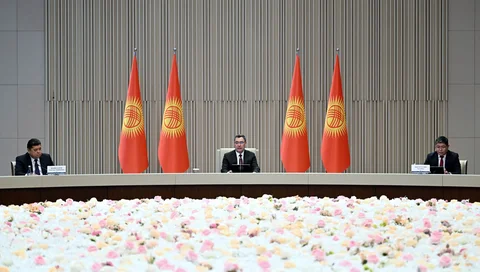
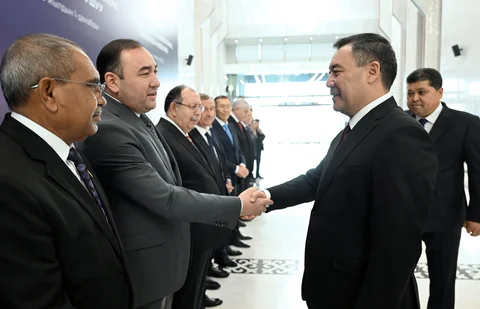
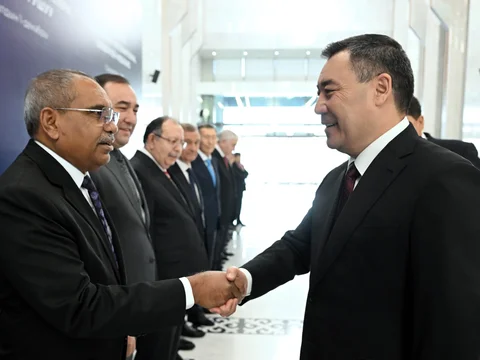
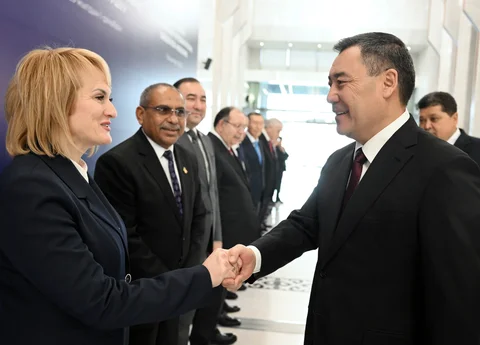
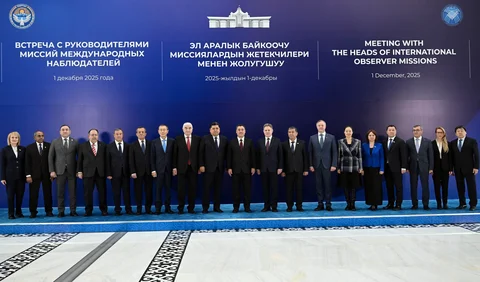
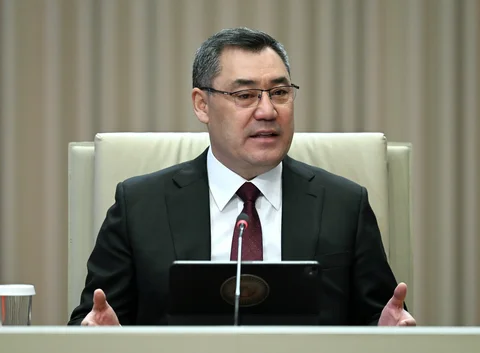

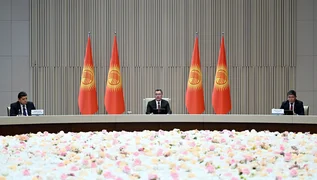
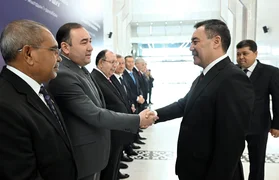
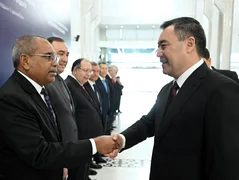
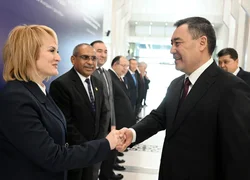
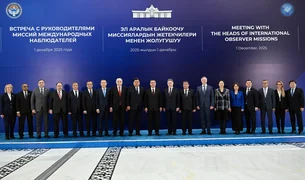
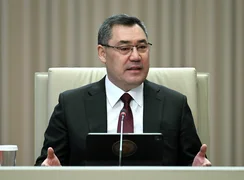
Bishkek, Dec. 1, 2025. /Kabar/. President Sadyr Zhaparov received the heads of international observation missions today, December 1.
The head of state expressed deep gratitude for their decision to observe the early parliamentary elections. A total of 788 international observers from 58 countries arrived in Kyrgyzstan.
“Such a broad representation of observers demonstrates the international community’s strong interest in the political processes taking place in our country,” the president noted.
He said he was confident that open and objective assessments and recommendations from observers would help Kyrgyzstan identify unnoticed shortcomings and determine further steps to strengthen democratic institutions.
President Zhaparov recalled that Kyrgyzstan had experienced three coups due to unfair and non-transparent electoral processes and emphasized that the country’s society is highly sensitive to the integrity of elections. “Democracy is not only the right to criticism and competition, but also the obligation to strictly follow the rules and respect the people’s final choice,” he said.
He noted that significant work had been carried out in recent years to improve electoral legislation and its implementation. Recommendations from international partners, particularly parliamentary assemblies and reputable international organizations, were taken into account in preparing for the current elections.
Digital technologies, biometric voter identification, an automatic electronic vote-counting system, an online voter registry, and a remote voting system were used. The president also emphasized that each voter had the right to vote at any convenient polling station.
For example, a resident of the At-Bashy district could vote for a candidate from their home district even while in Bishkek or abroad. To fully ensure the voting rights of Kyrgyz citizens living or temporarily staying abroad, 100 polling stations were opened abroad this year, compared to 59 in 2021. Zhaparov noted that this decision was positively received by citizens, adding that participation abroad tripled to 26,000 voters, compared with 9,000 in 2021.
He also spoke about plans to develop an online voting system that would be built with attention to identification and security requirements. The president emphasized that these elections were held entirely under a majoritarian system. “This system abolished party lists, which used to determine mandates behind the scenes, and placed emphasis on the personal qualities of candidates,” he said.
Tynchtyk Shainazarov, Chairman of the Central Election Commission, added that the observation missions had shared their findings on the parliamentary elections.
The heads of the missions presented their conclusions, noting that the electoral legislation of Kyrgyzstan aligns with generally recognized principles and norms of international law and provides a sufficient legal basis for conducting free and democratic elections.
They stated that the elections were open, fair, competitive, and consistent with democratic principles, ensuring the free expression of the will of the citizens of the republic.
The missions also praised the measures introduced to ensure gender equality under the majoritarian system, which limits the number of elected deputies of the same gender to two per constituency. They also highlighted the effectiveness of the remote voting mechanism, allowing citizens to vote at the nearest polling station if they are unable to vote at their permanent registration address.
The significant expansion of the overseas voting network—100 polling stations in 34 countries and 89 cities—was also recognized as a major step toward inclusiveness and accessibility.
In conclusion, President Zhaparov thanked the observers for their positive evaluations and constructive feedback. He noted that appropriate decisions would be made based on the missions’ recommendations and stated that the elections would serve as a strong foundation for further strengthening political stability, economic development, and the well-being of citizens.