Bishkek, Nov. 17, 2026. /Kabar/. Tajikistan has pledged to reduce greenhouse gas emissions by 10% by 2030 and 15% by 2035 compared with 1990 levels, with the potential to increase those targets to 25% and 40%, respectively, if sufficient international financing and technology are provided, Asia-Plus reported.
The commitments are outlined in the country’s updated Nationally Determined Contribution under the Paris Agreement (NDC 3.0).
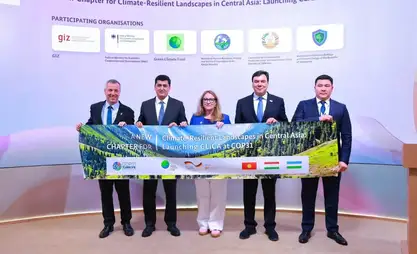
Bahodur Sheralizoda, chairman of the Committee for Environmental Protection under the Government of Tajikistan, announced the targets at the launch of the regional program Sustainable Climate Landscapes in Central Asia (CLiCA), held on the sidelines of the 31st Conference of the Parties to the UN Framework Convention on Climate Change (COP31).
Implementing the measures outlined in NDC 3.0 over the 2026–2035 period is expected to require between $20 billion and $22.5 billion, depending on the implementation scenario.
The funding is expected to come from both domestic and international sources, including concessional loans, grants, technology transfers, and investment.
Regional initiative to address climate challenges
The CLiCA program was first proposed in 2021 during discussions with the German development agency Deutsche Gesellschaft für Internationale Zusammenarbeit (GIZ). Funding for its initial development was partly provided through the Green Climate Fund’s Readiness Program, which GIZ is implementing in Tajikistan.
What began as a standalone initiative has since evolved into a regional program involving Tajikistan, Kyrgyzstan, and Uzbekistan. The three countries intend to cooperate on restoring degraded landscapes and strengthening the resilience of local communities to climate change.
Want to see more of Asia-Plus on Google? Add us as a preferred source.
Tajikistan is among the most climate-vulnerable countries in Central Asia. Its glaciers are rapidly retreating, water patterns are changing, and the risks of droughts, floods, and landslides are increasing.
These developments are placing growing pressure on ecosystems, infrastructure, and people’s livelihoods, despite Tajikistan’s relatively small contribution to global greenhouse gas emissions.
Participants at the program’s launch emphasized that water resources and ecosystems transcend national borders. Water security, agricultural production, and the well-being of communities across Central Asia are closely linked to the condition of Tajikistan’s mountain landscapes.
Two priorities for regional cooperation
The participating countries have identified two main areas of joint action.
The first involves identifying priority landscapes for joint investment in ecosystem restoration and improved water management, with the active involvement of local communities, particularly women and young people.
The second focuses on developing a monitoring system to assess not only the extent of restored land but also the actual impact of restoration efforts on ecosystems, water resources, and people’s livelihoods.
Tajikistan has reaffirmed its commitment to implementing the CLiCA program in cooperation with Kyrgyzstan, Uzbekistan, and international development partners.
Read More: https://asiaplus.news/en/2026/11/16/tajikistan-pledges-to-double-emissions-cuts-with-donor-support/