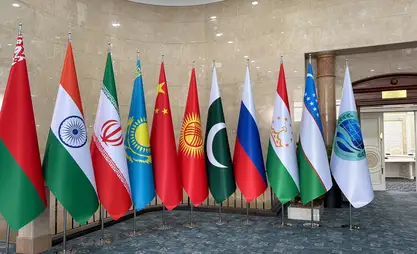
From Aug. 30 to Sept. 3, Chinese President Xi Jinping will attend the Shanghai Cooperation Organization (SCO) Summit 2026 in Bishkek and pay state visits to Kyrgyzstan and Egypt.
Amid an ever-evolving international landscape, Xi's upcoming trip is expected to foster collaboration among all parties to deepen practical cooperation. By pooling the strengths of the Global South, it is set to advance global governance reform, promote world peace and development, and facilitate the building of a community with a shared future for humanity.
CARRYING FORWARD "SHANGHAI SPIRIT"
Rows of freight trains stand ready at the China-SCO Demonstration Area in Qingdao, east China's Shandong Province, awaiting departure for Central Asia and Europe -- a striking visual testament to the growing vitality of SCO cooperation.
Guided by the Shanghai Spirit of mutual trust, mutual benefit, equality, consultation, respect for diverse civilizations and pursuit of common development, the SCO has expanded from six founding members to a 27-nation family. Demonstrating strong vitality and broad appeal, it has stood out as a model for a new type of international relations.
"Looking back, we have weathered the storms on our journey and emerged stronger because we have adhered to the Shanghai Spirit," Xi said in his speech at the 25th Meeting of the Council of Heads of State of the SCO in north China's port city of Tianjin last year.
Xi has attended every SCO summit since 2013, steadily shaping the grouping's development along the way. He has repeatedly called for carrying forward the "Shanghai Spirit" and forging an even closer SCO community with a shared future.
At the SCO Astana summit in 2024, Xi called for building a common home featuring solidarity and mutual trust, peace and tranquility, prosperity and development, good-neighborliness and friendship, as well as fairness and justice.
To further unlock the organization's potential, Xi told fellow SCO leaders at the Tianjin summit to seek common ground while shelving differences, pursue mutual benefit and win-win results, champion openness and inclusiveness, uphold fairness and justice, and strive for real results and high efficiency.
Also at the Tianjin summit, the organization mapped out a strategic blueprint for its development over the next decade and ushered in a new stage of high-quality development. Over the past year, China has implemented the major initiatives proposed by Xi and contributed to regional development through concrete actions.
Seven cooperation platforms -- covering green industry, digital economy, scientific and technological innovation, energy, higher education, vocational and technical education, and artificial intelligence -- have been launched, generating more than 160 projects. Meanwhile, steady implementation of the action plan for high-quality development of economic and trade cooperation continues to drive trade growth between China and SCO member states.
In the process of building an SCO community with a shared future, China has been both an architect and a driving force, said Sayfiddin Juraev, a professor of political science at Tashkent State University of Oriental Studies.
It is also at the Tianjin summit that Xi proposed the Global Governance Initiative, a vision that has rallied broad support across the international community.
Xi's vision consistently shapes not only the SCO's current agenda but also its long-term operating strategy, Sheradil Baktygulov, director of the Kyrgyz Institute of World Politics, told Xinhua. "The SCO's values of peace, equality, and mutually beneficial cooperation are reaching the global level."
NEW CHAPTER OF PARTNERSHIP
China and Kyrgyzstan, linked by mountains and rivers and united by close bonds between their peoples, are good neighbors, good friends and good partners, said Xi during talks with Kyrgyz President Sadyr Japarov in Beijing on Feb. 5, 2025.
Last year marked a high point in China-Kyrgyzstan diplomacy, with the two leaders meeting three times. Key engagements also included their back-to-back meetings on the sidelines of the second China-Central Asia Summit in the Kazakh capital of Astana in June and the SCO summit in Tianjin in August.
Kyrgyzstan's most valuable advantage is that it is a neighbor of China, Japarov has said. Invoking the ancient Chinese proverb -- "Amity and good-neighborliness are invaluable to a country" -- he noted that the saying aptly captures the essence of Kyrgyzstan-China relations.
Since establishing diplomatic ties more than 30 years ago, China and Kyrgyzstan have been supporting each other amid shifting global dynamics.
In recent years, under the strategic guidance of the two heads of state, China and Kyrgyzstan have elevated their ties to a comprehensive strategic partnership for a new era in the spirit of solidarity and mutual benefit, and are working together to build a China-Kyrgyzstan community with a shared future featuring good-neighborliness, friendship, and shared prosperity.
Practical cooperation between the two countries is gaining strong momentum, as seen in the China-Kyrgyzstan-Uzbekistan railway project, with construction well underway.
In a congratulatory letter to the commencement ceremony of the project in December 2024, Xi said that the construction of the railway is a strategic decision made by the three governments to promote regional connectivity, prosperity and stability, which also reflects the shared aspiration of the three countries to open up this strategic corridor.
Located in Central Asia, Kyrgyzstan was among the first countries to actively participate in Belt and Road cooperation. Projects such as the Chinese-built new North-South highway and the China-Kyrgyzstan-Uzbekistan highway enhanced regional connectivity and facilitated economic exchanges.
For years, China has been one of Kyrgyzstan's most important trade and investment partners, with two-way trade amounting to 27.2 billion U.S. dollars in 2025, up 19.8 percent year on year.
From pure honey to fresh orchard fruit, high-quality Kyrgyz agricultural goods are becoming household favorites across China. Meanwhile, on the streets of Kyrgyzstan, sleek Chinese new-energy vehicles are quickly becoming a familiar sight.
At the Irkeshtam Port on the China-Kyrgyzstan border, 24-hour freight clearance operations have helped speed up the flow of goods, streamlining cross-border trade for businesses on both sides.
The port also serves as a key gateway for Chinese exports, ranging from machinery to home appliances, as they travel onward to markets across Central Asia and Europe.
The bond between China and Kyrgyzstan runs deeper than trade -- it is also reflected in the growing exchange between their peoples.
In Bishkek, the Luban Workshop is helping train a new generation of skilled professionals. Its curriculum standards in areas such as smart water management and electrical equipment have been incorporated into Kyrgyzstan's national education system.
The two countries have also maintained close coordination on the international stage, working together within multilateral platforms such as the United Nations and the China-Central Asia mechanism.
"We are witnessing one of the most meaningful and fruitful periods in the history of Kyrgyz-Chinese bilateral relations," said former Kyrgyz Foreign Minister Alikbek Jekshenkulov. Xi's upcoming visit will represent not only another milestone, but also an opportunity to elevate bilateral ties to a new level, he added.
Source: Xinhua