A 5-year-old’s innocent question opens a window onto the joint efforts powering China-Kyrgyzstan-Uzbekistan railway
By Ma Jingjing
“Mom, how many bricks did you lift today?” That’s a question Tiulpana Kupesheva’s five-year-old son asks almost every day when she comes home from work.
Her son still doesn’t quite understand what his mother does for a living. “To him, I work for a railway company so that every day I must be hauling bricks and tiles at a construction site,” Kupesheva, who is the deputy head of the business and contracts department of China-Kyrgyzstan-Uzbekistan Railway Co. Ltd., tells me.
It is an adorable misunderstanding by a five-year-old. However, look deeper, in a way, the boy is absolutely right – this railway, and the regional connectivity it represents, isn’t being built on slogans. It’s being built by workers like Kupesheva, who spend their days poring over contracts, negotiating terms, and turning grand visions into signed pages. The China-Kyrgyzstan-Uzbekistan railway is being hammered out, line by line, meeting by meeting, brick by brick. And that, perhaps, is the most honest answer to the boy’s question: His mother may not be lifting bricks at a construction site, but she is helping lay the foundation of something that will one day connect an entire region.
Central Asia, located in the heart of the Eurasian continent, is home to towering mountains, fertile valleys, azure lakes and winding rivers – but has no access to the sea. As a vital corridor of the ancient Silk Road, the region’s development has long been constrained by its geography.
The China-Kyrgyzstan-Uzbekistan railway starts from Kashgar, an oasis city in the southwestern corner of China’s Xinjiang Uygur Autonomous Region, enters Uzbekistan via Kyrgyzstan, and can be extended to West and South Asia in the future. Once completed, it will inject strong impetus into the economic and social development of the three countries, Central Asia and broader regions, and will be a railway of development, friendship and happiness that serves the common interests of all parties.
“What distinguishes this project from previous ones is precisely that the transport agenda is now backed by tunnelling,” Kubat Rakhimov, executive director of Applicata – Centre for Strategic Solutions in Bishkek, capital of Kyrgyzstan, tells me.
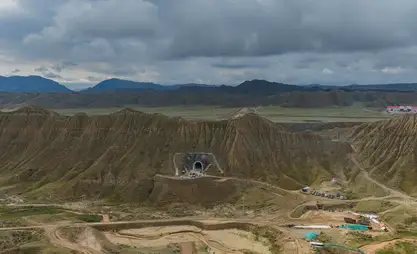
The railway section passing through the territory of Kyrgyzstan is more than 304 kilometers long, and full-scale construction work officially began last summer. This project is one of the most complex engineering undertakings: About 40 percent of the railway will pass through tunnels and bridges, with 27 tunnels and 41 bridges planned.
However, as an old Chinese saying goes, “When people are determined, they can overcome anything.” Despite various difficulties, the project is still moving forward smoothly, Arslanbek Kasymaliev, a deputy general manager of China-Kyrgyzstan-Uzbekistan Railway Co. Ltd., tells me.
“This is, first and foremost, thanks to the political will of the leaders of the three countries – their initiative and strong support – and it would not be possible without the tremendous efforts of a wide range of professionals. Today, we are here as a strong international team advancing this project, with engineers, designers, lawyers, financial experts and professionals from various fields from China, Kyrgyzstan and Uzbekistan,” Kasymaliev said.
At a deeper level, the project is also bringing the three countries, and China and Central Asian countries, closer in ways that go beyond steel and concrete.
From the ancient Silk Road to the upcoming rail link, the relationship between China and Central Asian countries is deeply rooted in history, driven by broad practical needs, and built on a solid foundation of public support. Today, it is brimming with vitality and dynamism.
With the China-Kyrgyzstan-Uzbekistan railway as an example, a new pattern of connectivity is taking shape at a faster pace. Under the Belt and Road Initiative, a series of cooperation projects in infrastructure and public welfare have taken root and borne fruit, including the Kapshagay photovoltaic power station and the Dushanbe-2 thermal power station, driving regional economic and social development and improving people’s livelihoods. New areas of growth including green and low-carbon development, finance, and digital innovation are being steadily cultivated, injecting fresh vitality into cooperation. China and Central Asian countries remain committed to common development as they jointly advance toward modernization.
Kupesheva’s five-year-old son may not fully understand what his mother does until he is older, but his daily question to her inadvertently echoed the hopes of many in the region: a desire for steady progress and the early completion of the China-Kyrgyzstan-Uzbekistan railway, which will be not merely a transport route, but a bridge for closer bonds.
The author is a chief reporter with the Global Times. majingjing@globaltimes.com.cn