Bishkek, Aug. 24, 2026 /Kabar/. The China-Kyrgyzstan-Uzbekistan railway is a landmark cooperation project within the "One Belt, One Road" initiative, the implementation of which is being personally promoted by the heads of state of China, Kyrgyzstan, and Uzbekistan. It is also a strategically important project for transport connectivity between China and Central Asia. The China Railway International project manager spoke during a Kyrgyz-Chinese press tour in Manas city.
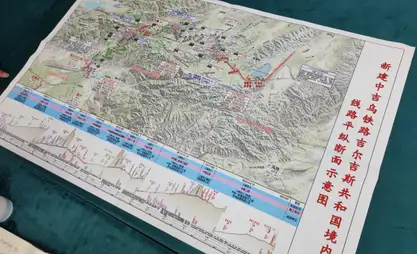
According to him, the railway route begins in Kashgar in China's Xinjiang Uyghur Autonomous Region, enters Kyrgyzstan via the Torugart Pass, then proceeds west through Manas city and ends in Andijan city of eastern Uzbekistan.
He noted that the Chinese side is responsible for constructing the section in China, while the Uzbek side is responsible for upgrading the section in Uzbekistan. China-Kyrgyzstan-Uzbekistan Railway Company LLC, jointly established by enterprises authorized by the governments of the three countries, is responsible for investment, financing, construction, and operation of the railway section in Kyrgyzstan.
"On the Chinese side, China Railway International LLC, a subsidiary of China State Railways, is leading the project's implementation, implementing the China-Kyrgyzstan-Uzbekistan railway project," he emphasized.
According to him, the China-Kyrgyzstan-Uzbekistan railway section in Kyrgyzstan is 304.84 km long. "This is a single-track railway with diesel traction and a reserve for subsequent electrification," he said.
The company representative emphasized that the design speed of trains is 120 km/h. The line has 20 stations, including the Torugart border station, the Makmal transfer station, and the Jalal-Abad border station.
He noted that the route passes through major mountain ranges such as Moldatoo, Khaylebeit, and the Fergana Range, and crosses numerous waterways, including the Arpa, Jamandavan, and Kichi-Alt rivers.
"In general, the terrain slopes downwards from east to west and is characterized by significant elevation changes. "The construction area is characterized by extremely harsh natural and climatic conditions, including high altitudes and low temperatures, strong winds, aridity, and challenging meteorological conditions, as well as complex engineering and geological conditions and hazardous geological processes, such as high seismicity, high geostress, and permafrost soils," he explained.
He added that limited transport access along the route, a shortage of construction resources, and a long winter period further complicate construction, making the project an exceptionally complex engineering challenge.
According to him, temporary access roads and temporary power supply facilities have been fully completed and commissioned throughout the entire section in Kyrgyzstan. It was emphasized that construction of 26 of the 29 new tunnels has begun, with one already completed; construction is underway on 40 of the 50 bridges; of the 107 roadbed sections, work has begun on 83.
"During the project's implementation, railway builders from the three countries are consistently pursuing an innovative approach. Considering the complex geological conditions of the 'four highs', high mountains, low temperatures, high geostress, and high seismicity, as well as the need to simultaneously accommodate both 1435mm and 1520mm track gauge standards, special attention is being paid to key technical challenges such as permafrost soils, unstable host rocks, concrete curing in high-altitude conditions, and the coordination of design and construction directly on-site," he said.
He added that technical research and technology improvement are ongoing. As a result, specialized technological solutions have been developed for mountainous and high-altitude regions, including tunneling technologies, deep drainage, roadbed construction, and bridge construction. According to him, this allows for the effective reduction of risks, increased productivity, and the resolution of complex technological challenges in railway construction in high-altitude and cold regions, ensuring improved quality and efficiency through technological innovation.