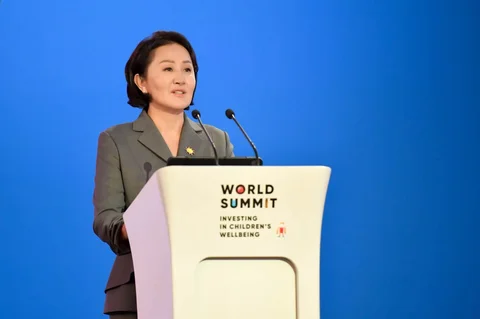
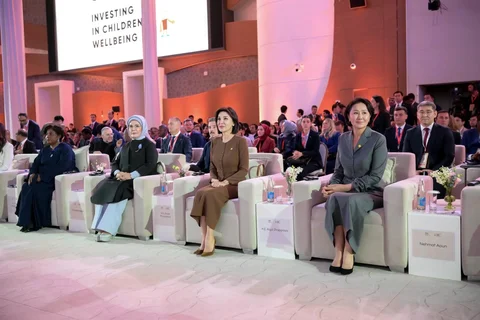
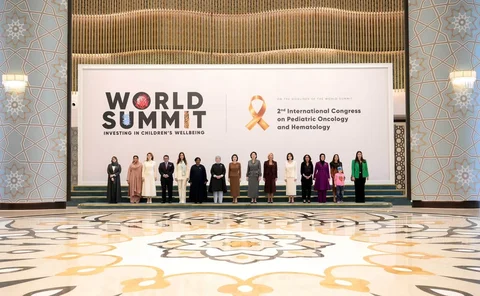

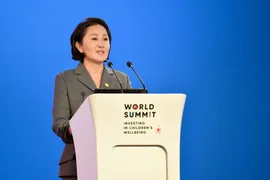
Bishkek, Oct. 22, 2024 /Kabar/. The First Lady of Kyrgyzstan Aigul Zhaparova, participated in the World Summit on "Investing in Children’s Well-being: A Path to Sustainable and Equitable Development for Future Generations" and the 2nd International Congress on Pediatric Oncology, both held in Samarkand, Uzbekistan.
In her address, Aigul Zhaparova spoke about the development of pediatric oncology in Kyrgyzstan, noting that funding for this sector has increased 200-fold in recent years.
According to her, treatment options for children with oncological diseases are being expanded in Bishkek and Osh; modern diagnostic and treatment infrastructure is being developed, and children are being provided with the necessary medications.
The First Lady also highlighted the significance of opening a palliative care unit at the National Center for Maternal and Child Welfare. She further noted that the first bone marrow transplant in Kyrgyzstan, performed in 2024, stands as another major achievement.
"For Kyrgyzstan, what matters is not the sheer volume of funds allocated, but the tangible changes achieved through these investments," Aigul Japarova remarked.
400,000 children diagnosed with cancer globally each year
In her speech, the First Lady drew attention to the ongoing challenges in the fight against pediatric cancer. Citing her data, she noted that approximately 400,000 children worldwide are diagnosed with cancer every year.
Aigul Zhaparova pointed out that the chances of recovery depend, to a large extent, on the country in which a child receives medical care. In high-income countries, more than 80% of children with cancer recover, whereas in low- and middle-income countries, this figure is significantly lower.
Among the primary challenges, she cited timely and accurate diagnosis, access to essential medicines and modern treatment methods, the professional development of medical specialists, and the financial burdens faced by families who must secure a full course of treatment for their children.
Kyrgyzstan calls for strengthened regional cooperation
Aigul Zhaparova emphasized that developing cooperation between nations in the field of pediatric oncology should be a key priority. She noted that international dialogue must be supported by concrete joint initiatives and practical solutions.
Key areas for collaboration include the exchange of experience, stronger ties between medical institutions, joint training and professional development for specialists, and the creation of support mechanisms for families who must seek medical care for their children abroad.
She also recalled a global initiative by the World Health Organization, which aims to ensure that at least 60% of children with cancer worldwide survive by 2030.
"I believe that Central Asia can make a significant contribution toward this goal and serve as an example of effective regional cooperation in saving children's lives. Every child, regardless of where they were born or where they live, has the right to timely medical care and high-quality treatment." "I am firmly convinced that, through our joint efforts, we can turn this opportunity into reality," concluded Aigul Zhaparova.
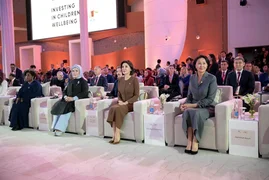
The summit brought together representatives from over 100 countries.
The events are also being attended by the first ladies of Uzbekistan, Albania, Zimbabwe, Lebanon, Pakistan, and Turkiye, as well as representatives of states and governments, international organizations, and leading experts and specialists from more than 100 countries around the world.
Participants are discussing issues related to ensuring children's well-being, healthcare, education, the protection of rights, and social support.
Following the summit, the adoption of the Samarkand Declaration on Investing in Children's Well-being is planned; it is intended to outline concrete actions and strengthen international cooperation in this area.