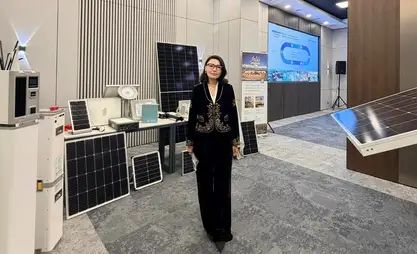
Kundus Kyrbasheva is one of the first business woman in the country to launch a wind farm and is contributing to the development of alternative energy. She is also actively involved in environmental issues and the green economy. In the upcoming interview, the entrepreneur will share how she came to this industry and her experience generating energy from solar and wind.
— Why did you choose the energy sector? What challenges did you face, and how did you overcome them?
— We viewed energy not just as a business, but as a strategically important sector for the country. Everyone knows that demand for electricity has been growing sharply in recent years. Therefore, it became necessary to not rely solely on hydropower, but to also utilize other energy sources. Developing alternative energy sources is one of the key ways to ensure energy security.
The main reason we chose a wind power plant is that this option had previously been virtually unused in the country. Being among the first in a new industry was challenging.
First, insufficient legal framework. Second, the issue of technically connecting the plant to the power grid. At the initial stage, there were also difficulties with land allocation and financing for the project's expansion.
We tried to address these issues systematically. We worked closely with relevant ministries, industry companies, and investors. Every step was documented and carried out within a legal and institutional framework.
— What is the stage of the project? Does it proceed as planned?
— We launched the plant in 72-hour test mode and connected it to the national power grid. The tests, conducted under the supervision of the energy supervision authorities, were successfully completed.
Following this, specialized calculation equipment was installed at the station, and we are currently completing the process of complying with state standards. Although the PPA (Power Purchase Agreement) has already been signed, it turns out that additional licensing procedures are required. We are currently going through these regulatory procedures and preparing the necessary documents.
This project was not only a pilot project for us but also provided important institutional experience. In practice, we saw how many documents and permits are required to connect renewable energy facilities, especially wind farms, to the grid. For example, while a solar power plant requires about 15 documents, a wind project requires approximately the same number.
In the next stages, in addition to increasing capacity, I saw the importance of streamlining procedures and reducing the number of documents. If we want to develop renewable energy sources more quickly, legislative regulation must be modern and effective.
— What did you learn from other countries' experience that helped to solve specific problems?
— In our practice, we've studied not only successful projects in other countries but also their mistakes. We're still in the research phase, so I think, the main results will come up once we launch the project. By integrating the successful experiences of other countries and adapting them to our conditions, many problems can be addressed proactively.
— Overall, what are the prospects for renewable energy sources in Kyrgyzstan, including solar and wind energy? What changes can be expected in the next 5-10 years?
— Kyrgyzstan's potential in this area is very high. It has ample wind resources and solar radiation. Currently, the country is primarily focusing on hydropower. In the future, over the next 5-10 years, we can expect an increase in small- and medium-capacity generation, the active installation of rooftop solar panels, the introduction of heat pumps, and the modernization of power grids. If we manage to increase the share of renewable energy to at least 5-7 percent, that will already be a major achievement. I consider this a strategically important area.
— What advice would you give to Kyrgyz women?
— I would like to tell Kyrgyz women: never limit yourselves. Don't be afraid to pursue careers in science, finance, and engineering. If we want our country to develop, women must actively participate in all sectors of the economy. This is a path that requires long-term commitment and strict discipline.