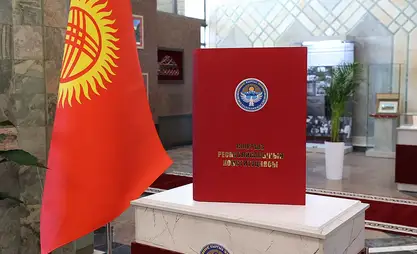
The people of Kyrgyzstan celebrate Constitution Day every year on May 5. The first Constitution of our country was adopted on May 5, 1993. This is not just an official holiday, but a major turning point in the political and legal development of the country.
The Constitution defines the political freedoms of the nation, the rights of citizens, and the boundaries of power. The Constitution of Kyrgyzstan has been amended several times. In each new edition, the power structure was reformed depending on the political situation. The current Constitution, adopted in 2021, transformed Kyrgyzstan into a state with a presidential form of government.
The strength and success of the Constitution lies in the implementation of its requirements. Therefore, Kyrgyzstan has the task of strengthening legal culture and ensuring the rule of law. This opinion was shared by Nurgul Atabekova, Doctor of Law, Vice-Rector for Science of the International University of Kyrgyzstan, in her interview with Kabar.
—Dear Nurgul, 33 years have passed since the adoption of the first Constitution of sovereign Kyrgyzstan. It has been repeatedly amended due to political situations. The latest edition was adopted in 2021, taking into account the successes and shortcomings of the years of independence, the demands of society, and the values of the Kyrgyz people. What do you think, what is special about this Constitution?
— I believe that the Constitution adopted in 2021 is the Constitution of a modern, progressive, developing democratic state. The preamble of the Constitution speaks of preserving the values and traditions of our ancestors, relying on the precepts of Aikol Manas, and living in harmony with nature in unity, peace, and harmony. This is where our ideology lies. Another novelty of our Constitution is the pursuit of social justice, economic prosperity, science, education, and spiritual development. The ideological vector is also contained here.
I would especially like to draw attention to the provision on the “social state”. The social and economic foundations of the constitutional system were first enshrined in the Constitution. Article 19 says that the state takes care of the well-being of the people and their social protection. This shows that the state's social policy is of great importance, it cares about its people. This can be seen from the fact that social policy has been actively implemented recently. This article states that Kyrgyzstan will develop social services, medical care, provide pensions, benefits and other guarantees of social protection.
Our Constitution emphasizes national values. For example, in paragraph 2 of Article 20, it is stated that respect for parents and taking care of them is a sacred duty of children. This is a tradition that our ancestors have been carrying forward. The inclusion of our national values in the Constitution allows us to bring them into the legal sphere and further strengthen them. And in Article 26, it is stated that a family is formed on the basis of voluntary marriage between a man and a woman of marriageable age. This provision paves the way for the establishment of a traditional family in Kyrgyzstan. As you know, in Western countries, people of the same sex are allowed to enter into marriage. This does not belong to our national values. Another noteworthy point is that the Constitution enshrines the right of children to a dignified life. Article 20, paragraph 3, states: “Children are the most valuable asset of Kyrgyzstan, and the state shall create conditions conducive to the comprehensive spiritual, moral, intellectual and physical development of children, thereby educating them in patriotism and citizenship.” This is considered a very progressive provision.
— Have you conducted any analysis of the trends of modern constitutionalism in Kyrgyzstan? What is your conclusions?
— First of all, I would like to note that the trends of constitutionalism are most clearly and distinctly reflected in our Constitution, adopted in 2021. For example, the naturalness, indivisibility, direct action of human rights and freedoms, their protection by law and the court, and the declaration of human rights and freedoms as absolute are consistent with the trends of constitutionalism. In addition, I would like to mention two general principles in Article 3 of our Constitution: the prohibition of actions and inaction of state and municipal employees that create conditions for corruption, and their constitutional, legal and other responsibility to the people. We can assess this as an action aimed at the development of the country and the prevention or elimination of corruption in the civil service. We also believe that it is necessary to expand the mechanism for implementing the articles and provisions enshrined in the Constitution. It is necessary to adopt relevant laws and ensure their implementation. In this regard, we have come to the conclusion that it is advisable to adopt an independent constitutional law in order to prevent arbitrariness of the authorities, ensure the systematic approach, stability, and consistency of their activities, and establish the responsibility of high-ranking officials.
— What is successful implementation of Constitution?
— I believe that the success of the Constitution lies in the observance of all its provisions by citizens and civil servants and the implementation of its ideas and provisions. It depends on the level of legal awareness and legal culture of the general public and civil servants. To increase legal awareness, it is necessary to widely disseminate constitutional values. From this point of view, a high level of legal education and legal culture of legal professionals contributes to the implementation of laws in the country as a whole. It also ensures the success of the activities of civil servants. Since last year, the Constitutional Court of Kyrgyzstan has been holding constitutional hearings together with educational institutions that train legal specialists. This year, we set a goal to organize one on an international level in Issyk-Kul on June 26-28. We invite teachers, scientists, and interested people who train employees of state bodies and lawyers to discuss the articles of the Constitution and improve its successful implementation and mechanisms.
— Thank you for your interview!