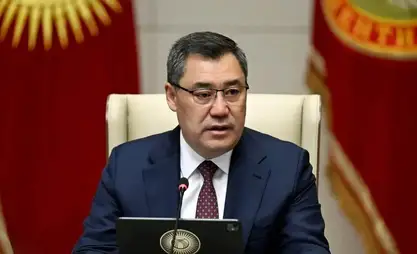
In an interview with the Kabar News Agency, President Sadyr Zhaparov responded to criticism regarding the state of freedom of speech and human rights in Kyrgyzstan. The head of state emphasized that citizens have the right to freely express their views and that freedom of speech in the country remains unchanged.
— Hello, Sadyr Nurgozhoevich. January 28 marks exactly five years since your official inauguration as President. How has Kyrgyzstan changed during this period? The work carried out by you and your team has been widely discussed in the media, including in neighboring Kazakhstan and Uzbekistan.
It has been noted that the country has resolved long-standing unresolved issues, launched large-scale international projects, and reached a new level of relations with partner countries.
At the same time, while acknowledging these achievements, some media outlets have pointed to certain shortcomings. In particular, claims have been made that the situation regarding freedom of speech and human rights in Kyrgyzstan has deteriorated. How would you comment on allegations that the country is allegedly rolling back democratic principles?
— Hello. We have both freedom of speech and democracy. Compared to the past, freedom of speech today is no less — and perhaps even greater. On social media platforms and in the media, our citizens freely express whatever they consider necessary. Whether it concerns social issues, political topics, government decisions, or personal problems, people write about them, produce videos, and speak out openly. No one restrains or restricts them for this. They freely express their opinions on any issue. Everyone can see this, read it, share it, and, when necessary, report on it.
Of course, some might say, “Aren’t certain individuals detained by law enforcement agencies? Aren’t human rights being violated?” But we mustn't forget that freedom of speech and democracy, above all, entail responsibility.
Law enforcement agencies do not detain people for expressing opinions or criticizing the authorities. They detain those who, under the guise of freedom of speech, covertly engage in activities aimed at destabilizing the situation in the country, or those who openly call for violations of the constitutional order. Or should we simply sit back and applaud them?
Depriving a person of liberty is not a joke. Law enforcement bodies act strictly on the basis of court authorization and conduct special operations. Audio and video evidence is collected.
For example, last autumn the public witnessed a conversation between a representative of one of the political parties and a foreign citizen, during which the organization of mass unrest was discussed. We all saw how he asked for financial and other forms of support.
When the law is violated, they then claim to be journalists or bloggers. Let them engage in journalism and blogging. We simply urge them not to break the law and not to hide behind the concept of “freedom of speech” when calling for various illegal actions.
Some, under the pretext of freedom of speech, incite interregional hatred. When such statements divide our people along territorial lines and pit residents of one region against another, should we simply stand by and wait to see who prevails?
Those who intend to hold protests on various issues may go to Gorky Park, invite the media, and express their demands there. The only requirement is not to approach government buildings or interfere with their work. This practice exists in many countries.
As soon as you say something, developed countries in Europe and America are immediately cited as examples. But what's really going on there? US immigration enforcement shot and killed two citizens under the pretext of insubordination. Trump sued BBC Radio for $5 billion.
What's happening in Europe? In almost every country, protesters are being violently dispersed, rallies are being forcibly dispersed, activists are being arrested, and others are being kept under surveillance. Both the media and international research institutes are reporting on this. This isn't necessarily a bad thing. In my opinion, the integrity of the state, its security, and its interests have become paramount worldwide.
Of course, I believe that all of this is in the interests of society as a whole, including those citizens who, sometimes overly emotional, declare a "lack of freedom of speech" and a "lack of democracy."
Therefore, as I said earlier, there are no restrictions on freedom of speech or human rights. The claims of one or two websites that there is "no freedom of speech" or "human rights are being violated" are unfounded.
Interviewed by Mederbek Shermetaliev, Director of Kabar News Agency