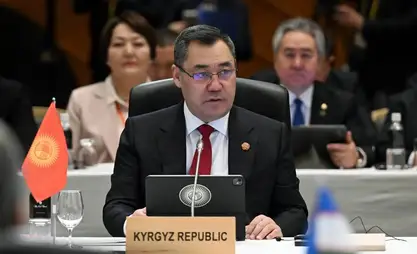
Bishkek, Dec. 20, 2025. /Kabar/. On December 20, as part of his official visit to Japan, President Sadyr Zhaparov addressed the First Summit of the Central Asia-Japan Dialogue in Tokyo.
In his speech, the head of state emphasized that today's summit expresses a shared desire to take the partnership between the countries of Central Asia and Japan to a qualitatively new level.
"Since the establishment of this dialogue, Central Asia has become a self-sufficient region demonstrating sustainable economic growth and development across all economic sectors. Given this positive momentum, building effective and long-term formats for our cooperation is particularly important," said Sadyr Zhaparov.
He confirmed that Kyrgyzstan supports Japan's proposal to focus joint work on three key areas: environmental sustainability, communications, and human resource development.
The president noted that climate change and sustainable development are key challenges for Kyrgyzstan as a mountainous country. Melting glaciers, declining water resources, and increasing mudflows and seismic activity directly threaten the population and infrastructure.
In this regard, he proposed, with Japan's participation, establishing a regional early warning system and developing data exchange on natural hazard forecasting.
The head of state emphasized Kyrgyzstan's commitment to a green economy, the development of renewable energy, and clean technologies, identifying the Kambar-Ata-1 hydroelectric power station as a key strategic project. He also expressed interest in the transfer of Japanese green technologies and new financing mechanisms for environmental projects.
The president recalled the UN initiative for the Five Years of Action for Mountain Regions 2023–2027 and invited partners to participate in the Second Global Mountain Summit in Bishkek.
Noting the high level of cooperation with Japan, Sadyr Zhaparov praised Japan's contribution to Kyrgyzstan's sustainable development and invited investors to participate in the Asman eco-city project.
In the context of developing communications and connectivity, the head of state emphasized that Kyrgyzstan's advantageous geographic location in the center of Eurasia opens up opportunities for it to become a regional hub for transport, logistics, trade, and financial flows. Improving connectivity, modernizing infrastructure, and implementing intelligent transport systems will reduce business costs and strengthen the country's position in regional logistics. Sadyr Zhaparov noted Kyrgyzstan's commitment to developing its road and rail networks, civil aviation, and transport and logistics centers, as well as expanding the country's participation in international routes.
He also expressed his readiness to cooperate with Japan in the field of information technology, identifying the High-Tech Park of Kyrgyzstan as a platform for implementing joint digital projects, transferring advanced Japanese technologies, and training engineering and IT personnel.
In his speech, the president also emphasized that human resource development is a key priority for cooperation with Japan.
He praised the results of the JDS program, whose graduates have contributed to the country's development for many years, and expressed interest in expanding educational quotas at leading Japanese universities, particularly in the fields of information technology and engineering.
Sadyr Zhaparov stated that cooperation in tourism is an important factor in bringing the peoples of Kyrgyzstan and Japan closer together. He noted that the country's rich historical and cultural heritage, formed at the crossroads of trade routes and civilizations, as well as the preserved elements of Buddhist culture, are of particular interest to Japanese tourists. In this regard, the head of state expressed his willingness to cooperate in preserving cultural diversity and creating a specialized museum complex.
In conclusion, Sadyr Zhaparov emphasized that Kyrgyzstan is consistently developing its tourism infrastructure with the goal of creating a year-round tourist season, noting the implementation of the major ski project "Ala-Too Resort" and inviting Japanese partners to participate in its development.