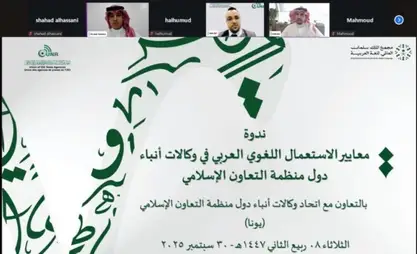
The Union of OIC News Agencies (UNA), in cooperation with the King Salman Global Academy for Arabic Language, on Tuesday, September 30, 2025, organized a virtual seminar entitled “Standards of Arabic Language Usage in the News Agencies of the OIC Member States.” The seminar saw wide participation from representatives of the member news agencies as well as a number of media professionals from various institutions.
In his speech during the seminar, Mr. Mohammed bin Abd Rabbo Al-Yami, Director-General of UNA, stressed the importance of linguistic standards in news agencies and ways to regulate and improve them, affirming that attention to this matter is part of caring for the Arabic language, which represents a fundamental pillar of Islamic identity.
Al-Yami explained that regulating linguistic standards in the news agencies of OIC member states is a complex issue, given the challenges associated with linguistic and dialectal diversity, differences in language and editorial policies from one country to another, and the weak communication among member states regarding these issues. He pointed out that UNA is keen to contribute to addressing this matter by monitoring the reality of the Arabic language in non-Arabic-speaking member agencies, documenting issues related to linguistic usage, and identifying challenges and ways to address them.
For his part, Prof. Dr. Mahmoud Al-Mahmoud, Head of the Sector of Linguistic Planning and Policy at the King Salman Global Academy for Arabic Language, emphasized that holding the seminar supports institutional efforts to improve media content, consolidates the role of the Arabic language in shaping media discourse, and ensures its quality, coherence, and professionalism.
He noted that in a rapidly changing media landscape with growing challenges, there is a pressing need for precise Arabic language and unified standards to regulate tools of expression, draft messages, and measure performance quality. He underlined that media language is not merely a linguistic issue, but a tool of influence and a source of credibility, expressing hope that this seminar would be the beginning of a joint scientific path aimed at consolidating linguistic standards in media drafting.
The first session, presented by Mr. Alzubair Al-Ansari, Media Advisor at UNA, under the title “Challenges in Regulating Linguistic Usage in the News Agencies of OIC Member States,” shed light on the main linguistic challenges faced in media performance, highlighting common mistakes in the news of non-Arabic-speaking member agencies and suggesting ways to overcome them in diverse and fast-changing media environments.
The second session, on “Linguistic Standards for Regulating Media Usage and Their Impact on Improving Language Practices in the News Agencies of International Organizations,” was delivered by Prof. Dr. Khalid Al-Qawsi, Director of the Department of Linguistic Policies at the King Salman Global Academy for Arabic Language. He reviewed the most important linguistic standards for regulating media use and their role in enhancing linguistic practices, while addressing the duality of language and media and the challenges posed by contemporary media.
The seminar concluded with a set of key recommendations, most notably the enhancement and exchange of Arabic content among OIC member agencies, cooperation in preparing a unified linguistic guide for member agencies that includes precise rules and standards for regulating linguistic usage in media texts, the development of a concise glossary of media and political terms through a joint database to be regularly updated and made accessible to all agencies, the implementation of regular training courses to enhance the competencies of employees in the news agencies of Islamic countries, the preparation of a training toolkit for employees of news agencies in international organizations focusing on skills and regulation of Arabic language usage in international media work, and the establishment of clear linguistic standards to regulate media language usage, activate them, and measure their impact within the news agencies of the OIC member states.