
Uzbekistan places a high priority on the development of the younger generation. This is not just a statement but a reality being actively implemented. Special attention is given to supporting young people in all aspects and addressing their existing challenges.
Working with youth in Uzbekistan is directly linked to demographic and social systems. Nearly one-third of Uzbekistan’s population consists of individuals under the age of 18, while 24% are between the ages of 18 and 30.
In Uzbekistan, social mobility mechanisms are being established to enable talented young people to realize their potential, and all necessary measures are being taken to support their growth.
Significant changes are taking place in education in the country. Over the past seven years, the number of master’s degree students has increased sevenfold, while the number of female students has risen elevenfold.
Furthermore, between 1991 and 2016, only 800 students could study abroad at the state’s expense. However, this number has tripled in the last seven years, with more than 2,300 students benefiting from the El-Yurt Umidi Foundation. The program continues to expand. This year alone, an additional 1,000 talented young individuals will be able to study at top foreign universities through the Bright Future Initiative.
However, the most essential progress is not just in quantity but also in the quality of education. Young people are no longer simply earning diplomas – they are mastering languages, modern technologies, and practical skills. Over the past three years, interest in learning foreign languages has grown significantly, with the number of young learners reaching 2 million. The number of students achieving high scores in the IELTS exam has increased fivefold, from 10,000 in 2020 to 53,000 in 2024.
The state will now cover a significant portion of the costs associated with language education. A new “2+6” financing system has been introduced, under which students initially pay for the first two months of private language courses independently, while the state funds the remaining six months. This initiative will provide 100,000 graduates with the opportunity to attain a B2 level proficiency, opening new career and educational prospects for them.
Additionally, more than 25,000 girls have received free programming training, which is set to double this year.
It is also worth highlighting the threefold increase in young entrepreneurs – one of the most significant achievements in recent years. Today, young people make up 40% of all business owners in the country, while youth unemployment has decreased by half.
To support this trend, a special fund with a budget of $100 million has been established under the Youth Affairs Agency. Through this fund, young entrepreneurs can receive preferential loans of up to 2.5 billion UZS, while their startups can attract investments of up to 2 billion UZS.
Additionally, Aloqa Bank is gradually transforming into a youth business bank. An additional $200 million has been allocated to finance startups and small enterprises. The minimum amount of support is set at 100 million UZS, while the maximum reaches 5 billion UZS.
Moreover, female entrepreneurs will receive at least 30% of the total loan volume. Employers who hire young specialists and pay them at least 3 million UZS will also benefit from tax incentives.
Creative industry parks are being established in the country, allowing residents to operate under a preferential tax regime until 2030. They will benefit from tax exemptions on profits and gain opportunities to develop projects in IT, design, marketing, and other creative sectors.
New educational and career opportunities are being created for young people living in remote districts. For instance, those proficient in a foreign language at the C1 level can receive an interest-free loan of 120 million UZS to open language schools in rural areas.
A new support system is also being developed for those who do not have the opportunity to study abroad but wish to acquire a prestigious profession. As part of the reforms, the El-Yurt Umidi Foundation will expand educational quotas in the world’s leading universities for key fields such as energy, transportation, urbanization, modern architecture, and medicine.
A distinguishing feature of the new reforms is the direct inclusion of students from foreign universities in the National Talent Pool. They can secure employment in government agencies without the need for competitive selection. This will enable the rapid integration of highly qualified professionals into public administration.
Additionally, every year, 1,000 selected young individuals will be able to study at universities ranked among the world’s Top 100. The state budget will cover all expenses related to their tuition and living costs, with 300 billion UZS allocated for this initiative. This program aims to build a strong pool of professionals who will contribute to the country’s further development.
Young researchers who obtain degrees from the Top 100 global universities will also be eligible for an interest-free loan of 800 million UZS to purchase housing.
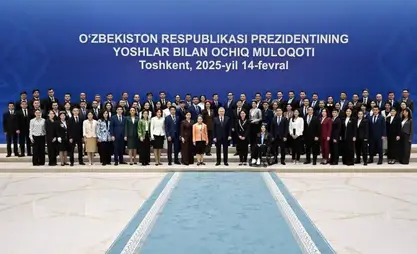
President Shavkat Mirziyoyev, during his meeting with young people on February 14, referred to the youth as the “golden foundation” of the nation. In Uzbekistan, meetings between leaders and young people are becoming a well-established tradition. These gatherings are essential for discussing measures to expand opportunities for the younger generation.
Bekhruz Khudoyberdiyev, UzA