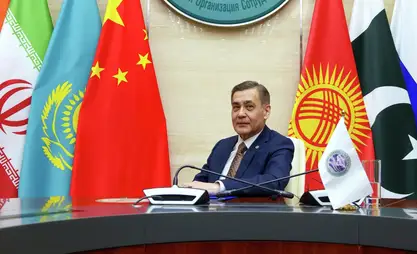
In August of 2026 Bishkek will host the Shanghai Cooperation Organization summit, with the participation of the presidents of the organization's member states. This year's summit coincides with the 25th anniversary of the SCO. In this regard, SCO Secretary General Nurlan Yermekbaev gave an interview to Kabar News Agency, in which he discussed the priorities of Kyrgyzstan's chairmanship and the key objectives of the Organization for 2026.
- In 2026, the SCO celebrates its 25th anniversary. Could you please tell us about the priorities of Kyrgyzstan's chairmanship this year?
On the occasion of its 25th anniversary, the Shanghai Cooperation Organization (SCO) has evolved from a group of six member states into the world’s largest transregional organization, with its influence on the international stage steadily growing.
Over time, the SCO has developed into a platform reflecting a systemic model of interstate partnership at the global level, with an increasingly prominent and persuasive voice in international affairs.
At the same time, the organization is not standing still. The current global environment requires adaptation and renewal. In this context, the heads of state have set a task of comprehensive modernization of the SCO’s activities, including improving institutional and sectoral mechanisms, as well as updating the existing legal framework.
In 2025, the Kyrgyz Republic assumed the chairmanship of the SCO. The chosen theme — “25 Years of the SCO: Together Towards Sustainable Peace, Development, and Prosperity” — underscores both continuity and a forward-looking agenda.
The priorities of the Kyrgyz Chairmanship for 2025-2026 are as follows:
Ensuring long-term stability. Without sustainable peace, neither economic development nor humanitarian cooperation is possible. The SCO countries will continue their efforts to counter the "three forces of evil" – terrorism, separatism, and extremism – as well as new challenges such as cybercrime, illicit trafficking of narcotics and precursors, human trafficking, transnational organized crime, and other threats.
Realizing the potential of economic cooperation. Consultations on the establishment of an effective financial mechanism for the Organization (the SCO Development Bank) will be held soon. The creation of such an institution could be an important step towards providing the SCO with its own instrument for funding various programs in relevant economic sectors, including, for example, small and medium-sized businesses, as well as for conducting market research and identifying and synergizing promising projects.
Creating favorable conditions for international road and rail transport. The development of new transport routes and the effective use of the transit and transport potential of SCO member states are envisaged.
Digitalization. Digital technologies are becoming the foundation not only of the economy, but also of public administration, education, medicine, and many other sectors. Digitalization should not divide, but rather unite the SCO community by creating a unified digital space of trust and cooperation.
During its chairmanship, Kyrgyzstan intends to propose a future-oriented approach, making digital transformation a priority for joint work. Thus, Bishkek has initiated the SCO Youth Digital Forum. This platform is intended to become a catalyst for digital innovation, bringing together talented young programmers, engineers, researchers, and entrepreneurs. The forum will focus not only on the exchange of ideas but also on practical results, i.e., the launch of joint projects.
Digital opportunities are inseparable from cyber threats. In this regard, the exchange of experience on cybersecurity, digital infrastructure, and artificial intelligence is relevant.
Expanding cultural and humanitarian cooperation. Today, the bulk of practical activities in the SCO are focused on trade and economic cooperation, as well as cultural and humanitarian cooperation. The SCO is a community of peoples united by mutual respect and friendship. Cholpon-Ata has become the SCO's tourism and cultural capital during the Kyrgyz chairmanship, hosting the anniversary Issyk-Kul Intellectual Forum, first held in 1986 at the initiative of the renowned writer Chingiz Aitmatov.
Ecology and Sustainable Development. Climate change is a serious challenge. The SCO region encompasses a wide variety of ecosystems—from mountains and steppes to deserts and permafrost—and the consequences of global warming affect us all. They directly impact energy, agriculture, water resources, and sustainable development.
To intensify joint action to combat climate change, the Kyrgyz side proposes creating an Emergency Assistance Fund (mechanism) to respond to emergencies and provide assistance.
What are the Organization's goals in 2026, and what key activities are planned?
In the coming period, in accordance with the SCO Development Strategy to 2035, member states intend to strengthen mutual trust and good-neighborliness, jointly counter traditional and new security challenges, deepen practical, cultural, and humanitarian cooperation, improve the Organization's activities, expand its external relations, and enhance its international authority.
The Kyrgyz Republic's chairmanship of the Organization combines the implementation of the agreements reached at the Tianjin Summit (China, September 2025) with new initiatives. As stated above, Bishkek's priorities include ensuring long-term stability, including through the implementation of the Agreements establishing specialized permanent bodies such as the Universal Center for Countering Security Challenges and Threats to SCO Member States in Tashkent and the SCO Anti-Drug Center in Dushanbe. The Universal Center includes the Information Security Center in Tashkent and the Center for Combating Transnational Organized Crime in Bishkek. A Program for Cooperation between Member States in Countering Extremist Ideology in the SCO Space for 2026–2030 was also approved.
A plan of activities for 2026 has been agreed upon. It includes meetings of traditional mechanisms of interaction in the areas of politics, security, economics, and humanitarian cooperation, including meetings of the Council of Heads of State, the Council of Foreign Ministers, meetings of heads of relevant ministries and agencies, as well as events organized by the SCO Youth Council and several other structures.
In the area of practical cooperation, the main event will be the meeting of the Council of Heads of Government (Prime Ministers) of Member States, which Tajikistan chairs this year. In addition, meetings of ministers responsible for foreign economic and trade activities, as well as ministers of agriculture, energy, and transport, will be held.
The SCO's external relations will continue to develop, including enhancing practical interactions with dialogue partners and observer states. A series of joint events is planned with the UN Secretariat and specialized agencies of the Organization—UNODC, ESCAP, and UNEP—as well as traditional partners from regional organizations—the CIS, CSTO, CICA, and the EAEU.
How do you assess the prospects for deepening foreign policy coordination among SCO member states and jointly strengthening regional security in the face of growing global instability?
Significant changes are currently taking place in global politics, economics, and other areas of international relations. A more equitable multipolar world order is emerging, opportunities for national development and mutually beneficial and equitable international cooperation are expanding. At the same time, coercive measures are being used, international law is being systematically violated, geopolitical confrontation and conflicts are escalating, and risks to stability in the SCO region and the world as a whole are multiplying.
Looking back on the Organization's formation and development, I emphasize that maintaining peace, security, and stability has been and remains one of the key points of convergence among the interests of its member states. Today, the SCO has already become a key player in the system of international cooperation. Member states believe it is essential to enhance the SCO's role in fostering conditions for strengthening global peace and security, as well as building a new democratic, equitable political and economic international order.
The SCO advocates respect for the rights of peoples to independently and democratically choose their paths of political and socioeconomic development. We believe that the principles of respect for the sovereignty, independence, and territorial integrity of states, equality, mutual benefit, non-interference in internal affairs, and non-use of force or threat of force are the foundation for the sustainable development of international relations.
We are committed to the peaceful resolution of differences and disputes between countries through dialogue and consultation. We oppose confrontational approaches to resolving international and regional development issues and countering traditional and new security challenges and threats.
The Organization's member states, relying on similar or converging assessments of the current regional and global agendas in accordance with the principles of the SCO Charter and the "Shanghai Spirit," characterized by mutual trust, mutual benefit, equality, mutual consultation, respect for cultural diversity, and a commitment to joint development, are steadily building the potential for cooperation in a wide range of areas, thereby making a valuable contribution to peace and development in the region and globally.
Political statements are the SCO's primary tool for responding to situations that threaten peace, security, and stability in the region. Thus, in 2025-2026, nine statements were agreed upon and adopted on behalf of the Organization, some of which were initiated by the SCO Secretariat.
Today, we are actively working to improve the SCO's activities in line with the demands of the times, including modernizing mechanisms for countering security challenges and threats and expanding specialized cooperation in combating terrorism, separatism and extremism, drug trafficking, arms smuggling, and other forms of transnational organized crime.
We are convinced that enhancing the SCO's effectiveness will contribute to deeper foreign policy coordination among member states and, ultimately, strengthening regional security.