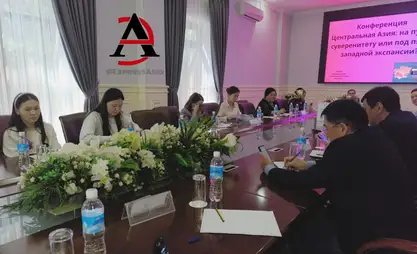
Bishkek, April 22, 2026 /Kabar/. Public figures, think tank representatives, and journalists discussed ways to strengthen cooperation among Central Asian states and their right to independently determine their development paths in Bishkek.
The discussion platform provided an opportunity for a free and open exchange of opinions on the external risks facing the countries of the region as a result of geopolitical transformations. Central Asia is becoming a space where a struggle for influence is unfolding, and a number of associated factors do not always align with national interests. These interests are often conflicting with externally imposed conditions and rules, as well as demands put forward by individual states' sanctions policies. Furthermore, adherence to certain standards is becoming a criterion for granting investment loans.
It was emphasized that partnership within Central Asia should be based on shared cultural roots and a cooperation model focused on mutual respect and consideration of national interests.
According to the organizers, the following analytical conclusions were formulated following the roundtable:
- Real independence today requires not only political autonomy, but also economic, informational, and, most importantly, civilizational sovereignty.
- Deepening cooperation within existing Eurasian integration associations (SCO, EAEU, CIS) contributes to addressing common problems and increasing the region's resilience.
- Modern challenges require not so much direct confrontation as the development of strategies based on analysis, adaptation, and the promotion of national interests.
The roundtable participants agreed that Central Asia possesses significant potential for self-sustaining development. However, successfully realizing this potential requires a deep understanding of both internal resources and external challenges, as well as the development of balanced, independent policies. As the meeting's initiators emphasize, the discussion in Bishkek was an important step in understanding these complex processes and formulating further paths to strengthening the region's sovereignty.