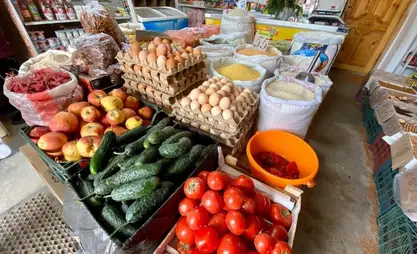
Bishkek, Dec. 11, 2025. /Kabar/. Rising food prices in Kyrgyzstan are due to a combination of internal and external factors, Uran Chekirbaev, head of the food security department at the Ministry of Water Resources, Agriculture, and Processing Industry told Birinchi Radio.
He stated that nine key food products are essential in the country, including meat, vegetable oil, bread, and sugar. The standard annual sugar consumption is approximately 170,000 tons, but actual consumption is approximately 100,000 tons. This difference is explained by the fact that some of the sugar is replaced by other sugar-containing products, such as candy, chocolate, and other goods. "If all these products are taken into account, actual consumption could well reach the standard," he noted.
Chekirbaev emphasized that price fluctuations for carrots are automatically reflected in the prices of other vegetables, as these products are interrelated. "Carrots can be considered an indicator. If one product rises in price, others may also rise, but not always," he explained.
He recalled that during the period when the price of carrots exceeded 100 soms, the price of potatoes and onions remained stable due to a carrot shortage in Russia and Belarus, which began actively purchasing carrots from Kyrgyzstan.
"In such situations, one can rejoice and cry. High prices are beneficial for farmers, but they have a heavy impact on those who spend a significant portion of their income on food," Chekirbaev said.
He emphasized that Kyrgyzstan is among the countries where the share of household expenditure on food remains among the highest: while in developed countries, 5-10% of income is spent on food, in Kyrgyzstan it is significantly higher. Therefore, price changes are noticeable for the majority of the population.
From the perspective of producers, high prices seem positive, as more than 60% of the country's population lives in rural areas, and farmers' incomes are directly dependent on the market. However, inflation affects not only food products but also raw materials, machinery, and services related to cultivating and harvesting.
"If food prices had not risen, but farmers' expenses had increased, farms would have suffered losses and would not have been able to produce at the required volumes next year," the expert explained.
Among the internal factors, Chekirbaev cited GDP growth and rising wages in public and private organizations, which are increasing consumption and affecting prices.
At the same time, he noted that the inflation rate and the cost of basic foodstuffs in Kyrgyzstan are lower than in its main trading partners—Russia and Uzbekistan. For example, meat prices in Kyrgyzstan are significantly lower than in Uzbekistan and Kazakhstan.
External factors, he cited:
- high inflation in partner countries;
- the influence of the geopolitical situation and tariff wars, which increase the cost of logistics, especially food;
- the dependence on imports of certain product groups—primarily fruits, citrus fruits, and bananas;
Climate change—the drought observed worldwide over the past two to three years—is a factor.
"There are food products, but due to external factors, especially tariff wars and logistics, they are becoming more expensive, and this inflation is coming to Kyrgyzstan," he concluded.