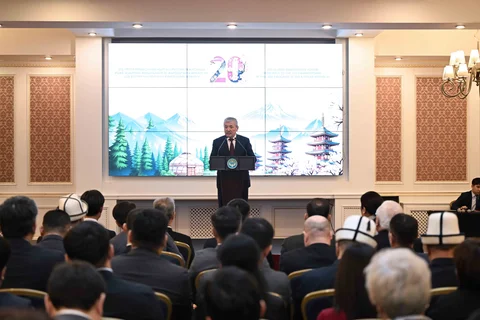
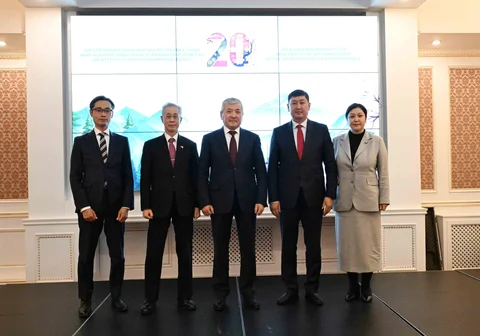

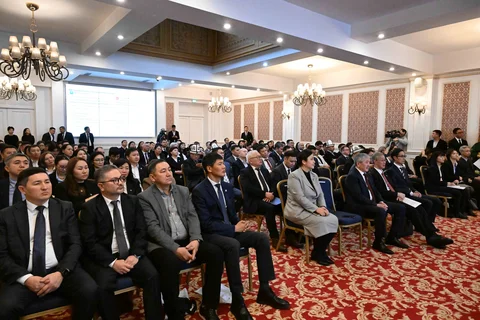

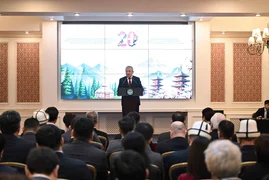
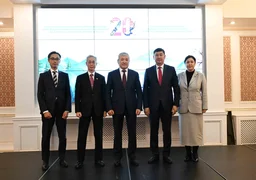

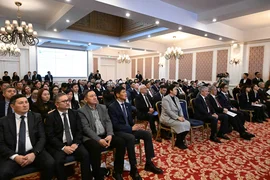

Bishkek, Feb. 27, 2026. /Kabar/. Chairman of the Cabinet of Ministers Adylbek Kasymaliev participated in a forum dedicated to the 20th anniversary of the Japanese Human Resources Development Scholarship Program (JDS) in the Kyrgyz Republic.
Adylbek Kasymaliev noted that the Cabinet of Ministers views human capital development as a long-term strategic priority for the country. He expressed interest in further expanding the JDS program and creating new opportunities for young civil servants.
"Over the 20 years of the Human Resources Development Scholarship Program, more than 300 of our citizens have received education at leading universities such as Ritsumeikan, Meiji University, Tsukuba University, Hiroshima University, and Japan International University." "Undoubtedly, the knowledge they acquired in science and technology, international relations, social development, economic policy, public administration, regional development, business administration, information technology, and innovation has and will continue to have a direct and indirect impact on our society and economy. Our compatriots educated in Japan today occupy positions of responsibility in government agencies, international organizations, and academia, contributing to the country's socioeconomic development. This is a tangible result of the program," he said, expressing gratitude to the Japanese Embassy in the Kyrgyz Republic, as well as JICA and JICE, whose systematic support has significantly contributed to strengthening relations between the two nations and developing human resources.
Adylbek Kasymaliev continued that Japan was the first Eastern country to achieve an economic miracle and became a model for countries like Korea and Malaysia, as well as a vanguard of global scientific and technological development. He added that Japan's experience strengthens confidence that an Eastern country like Kyrgyzstan is also capable of achieving the highest levels of success.
Chairman emphasized that the JDS program is a long-term strategic mechanism aimed at strengthening the state and developing human resources. In this context, he noted that the program's graduates represent a generation that combines an education received in a leading country with national responsibility. Thanks to this program, each graduate received a high-quality, modern education and is ready to make a worthy contribution to the development of our people and economy.