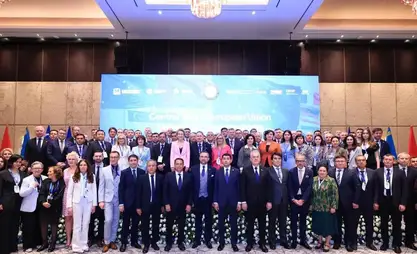

Bishkek, April 14, 2026 /Kabar/. The Central Asia – European Union Universities Congress kicks off in Samarkand, Uzbekistan, bringing together representatives of government agencies, higher education institutions, and international organizations from Central Asian countries and the European Union member states.
According to the Ministry of Science, Higher Education, and Innovation of Kyrgyzstan, more than 300 representatives of the educational community, including ministers, deputy ministers, university heads, and international experts, are participating in the event.
Durus Kozuev, Deputy Minister of Science, Higher Education, and Innovation, is representing the Kyrgyz Republic at the congress.
During panel session dedicated to new areas of cooperation between universities in the European Union and Central Asia, the deputy minister delivered a report outlining key priorities for developing the partnership.
"For the Kyrgyz Republic, cooperation with the European Union in higher education is a key area focused on developing human capital, modernizing the education system, and strengthening institutional capacity. Of particular importance in this process are the Erasmus+, Erasmus Mundus, Twinning, and DARYA programs, which promote the implementation of modern educational approaches, develop academic mobility, and strengthen university capacity.
Priorities include expanding dual degree programs, developing joint educational and research initiatives, forming inter-university consortia, and deepening cooperation within the Central Asia-European Union framework. We are confident that pooling the potential of universities will create a sustainable platform for training competitive personnel, developing science, and promoting innovation.
We also note the positive dynamics of cooperation in higher education with the Republic of Uzbekistan and other Central Asian countries. Our countries are consistently strengthening direct ties between universities, expanding academic mobility, and implementing joint educational and research initiatives," said Durus Kozuev.
It is noted that the congress is viewed as an important international platform for developing joint solutions aimed at developing higher education, science, and innovation.
The congress places particular emphasis on expanding double degree programmes, conducting joint research in artificial intelligence, biomedicine and green technologies, increasing participation in the Erasmus+ and Horizon Europe programmes, and strengthening cooperation between universities and industry.