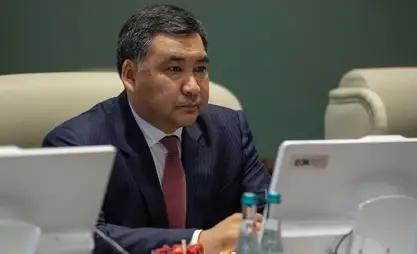
Bishkek, April 27, 2026. /Kabar/. First Deputy Chairman of the Cabinet of Ministers of the Kyrgyz Republic Daniyar Amangeldiyev, as part of a working visit to Moscow, participated in the regular meeting of the Council of the Eurasian Economic Commission (EEC).
According to the Cabinet of Ministers' press service, the meeting's agenda included 40 issues covering key areas of integration cooperation, 19 of which were adopted by Council members without discussion.
The agenda included a report on the current state of development of the Union's common electricity market. The EEC Council approved a draft resolution of the Supreme Eurasian Economic Council (SEEC) providing for the updating of the Action Plan for the creation of a common electricity market. The decision was also made to amend the Customs Union regulations regarding certain types of light-emitting diode (LED) modules. Specifically, modules (EAEU TN VED code 8539 51 900 1) are exempt from customs duties in quantities of up to 23 million units per year for the period up to and including June 30, 2028.
The action plan for the integration of national information systems was also approved. This involves creating a unified mechanism for the traceability of animals and animal products through the integrated EAEU information system. This will ensure transparency in the movement of products and strengthen veterinary control throughout the Union.
The decision was made to approve the results of the joint study group's work to study the feasibility of concluding a free trade agreement between the EAEU and the Republic of Tunisia.
The draft decision on initiating negotiations with the Republic of Tunisia on concluding a free trade agreement will be considered by the heads of state at the next meeting of the Supreme Eurasian Economic Council. To ensure macroeconomic stability, a number of decisions were adopted to strengthen the EAEU regulatory framework. Specifically, the EEC Commission was tasked with developing a set of joint measures to curb inflation in the Union's member states.
To reduce the administrative burden on manufacturers, amendments to the Requirements for the Quality Management System of Medical Devices were approved, simplifying the outsourcing of sterilization processes.
This change will allow manufacturers to reduce the cost and timeframe of production inspections, while inspection organizations will use their resources more efficiently. This optimization increases the availability of medical devices for the healthcare systems of the Union's member states.
A package of decisions was also adopted on the introduction of identification labeling for new product groups:
Construction materials and paints and varnishes (in consumer packaging).
Children's goods (toys and games for children under 14).
EAEU member states have the right to independently determine the date of introduction and the labeling procedure within their territory, by notifying the Commission no later than six months prior to the start of the procedure. Following the meeting, the Council approved the agenda for the upcoming meeting of the Supreme Eurasian Economic Council, scheduled for May of this year in Astana.