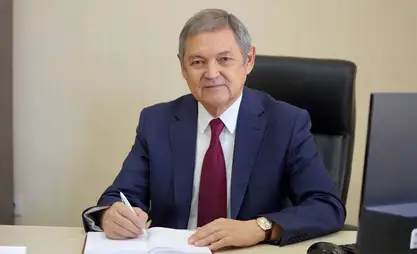
Bishkek, April 7, 2025. /Kabar/. During his speech at the international forum "Central Asia in the Face of Global Climate Threats: Solidarity for Common Prosperity" in Samarkand, President of Kyrgyzstan Sadyr Zhaparov proposed a number of key initiatives to solve Central Asia's climate problems, Uzbek scientist Ismail Saifnazarov told Kabar.
Professor of the Tashkent State University of Economics, Chairman of the Association of Philosophers of Uzbekistan, former deputy of the Legislative Chamber of the Oliy Majlis of the Republic of Uzbekistan, Doctor of Philosophy Ismail Saifnazarov said that the climate change has a serious impact on the environment and economy, and mountainous regions, especially in developing countries, are becoming the most vulnerable. In Kyrgyzstan, climate change manifests itself through melting glaciers, droughts and landslides, which pose a threat to both the environment and social stability. These regions often remain in the shadow of major climate initiatives, despite their key role in ecosystems.
"Mountain ecosystems provide important water resources and support biodiversity, and their degradation can lead to catastrophic consequences. President of Kyrgyzstan Sadyr Zhaparov emphasizes the need to take into account the interests of mountainous countries along with small island states and least developed countries, whose problems traditionally receive more attention in international forums," the professor noted.
The Uzbek scientist believes that one of the key initiatives of Kyrgyzstan is the creation of a mechanism for exchanging external debt for sustainable development projects, which is of great global importance.
"This decision will allow the redirection of funds freed from debt payments to environmentally sustainable projects and adaptation to climate change. Such an initiative can become an example for other countries facing debt problems and climate threats,” the scientist emphasized.
Further, Professor Saifnazarov drew special attention to the active development of such renewable energy projects in Kyrgyzstan as small hydro power plants and reforestation programs.
“These measures help reduce dependence on coal and carbon emissions, in line with international decarbonization goals. In particular, the Zhashyl Muras program, aimed at greening, contributes to the absorption of carbon dioxide and the fight against climate change,” the expert noted.
Professor Saifnazarov highly appreciated Kyrgyzstan’s support for the Five Years of Action for the Development of Mountain Regions (2023–2027) and the organization of international events within the framework of this initiative, seeking to integrate mountain countries into the global climate agenda and ensure climate justice.
“This step underlines the need to uphold the principle of climate justice and achieve the goal of ‘Leaving no one behind’, which is at the heart of global climate policy,” as the Kyrgyz leader rightly emphasized,” he said.
In conclusion, the Uzbek scientist noted that the proposed measures — external debt swap, support for renewable energy sources and greening — provide mountain regions with an opportunity not only to mitigate the effects of climate change, but also to increase their resilience.
“Kyrgyzstan’s approach, focused on solving the specific problems of mountainous countries, can become an example for other states striving for sustainable development and climate justice,” Professor Ismail Saifnazarov concluded.