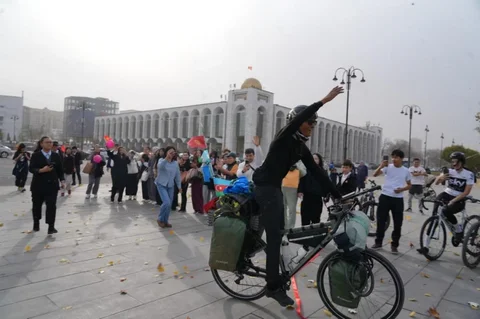

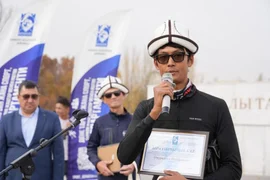

Bishkek, Nov. 11, 2026 /Kabar/. Bishkek welcomed Kyrgyzstani traveler Nasirdin Omuraliev at Ala-Too Square, who completed a cycling journey from Europe to Kyrgyzstan.
According to the municipal authorities, he began his route in Poland.
Travelers Nasirdin Omuraliev and Marco Fontello were welcomed by Deputy Mayor of Bishkek Rakhat Musaeva, representatives from the City Hall’s Department of Physical Culture, Sports, Tourism, and Youth Affairs, as well as young cyclists from the "Zhenish" Specialized Children and Youth Sports School.
Addressing the guests, Rakhat Musaeva noted that Nasirdin Omuraliev’s journey serves as an example of determination, courage, and love for his homeland. She added that the trip also helps promote Kyrgyzstan, its history, culture, and tourism potential.
"It is especially symbolic that your journey concludes here in Bishkek, on the central Ala-Too Square. Our capital is always open to guests, international friendship, and cooperation. The joint journey of Nasirdin and Marco proves once again that sport unites people, regardless of their age or nationality," the deputy mayor remarked.
According to Nasirdin Omuraliev, the primary goal of the trip was to traverse historical routes once followed by his ancestors, honor their legacy, introduce other nations to Kyrgyzstan, and contribute to the development of his homeland. During his travels, at the port of Alyat in Azerbaijan, Nasirdin met a 64-year-old Italian citizen named Marco Fantello. Following this encounter, they decided to continue their journey together and eventually arrived in Kyrgyzstan.
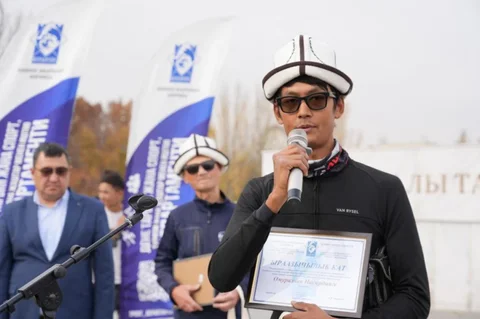
As a gesture of respect during a celebratory welcome, the travelers were presented with traditional *ak kalpak* hats, which were placed on their heads, as well as letters of appreciation and commemorative gifts.