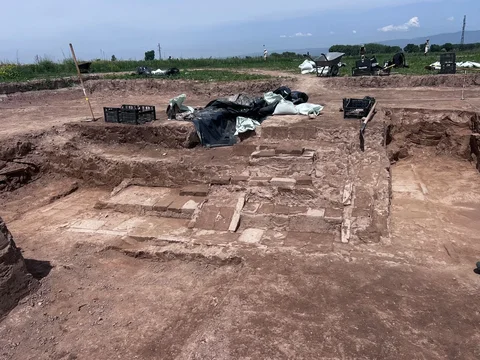
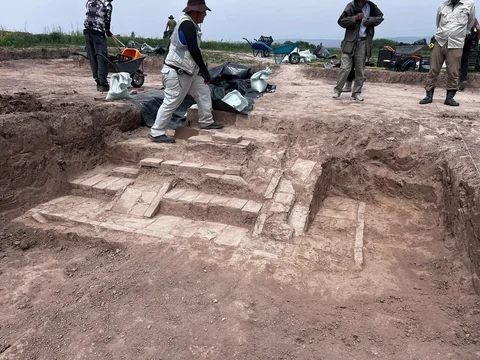
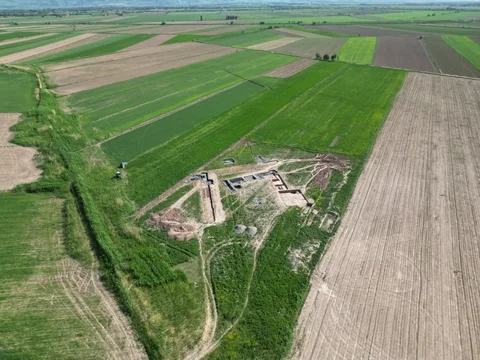
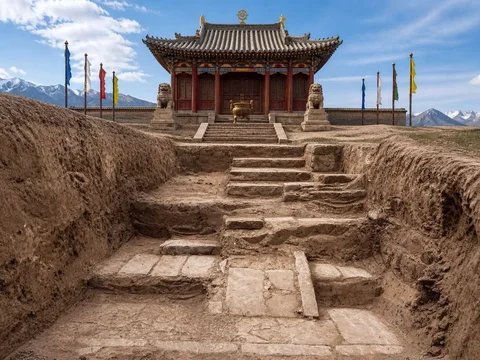

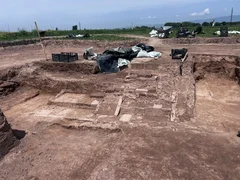
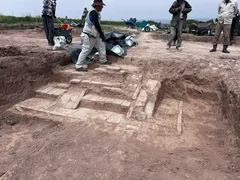
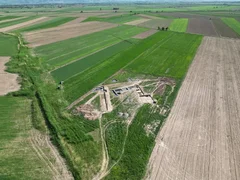

Bishkek, May 7, 2026 /Kabar/. On the site of the medieval Ak-Beshim (Suyab) settlement in Chui region, a Kyrgyz-Japanese archaeological expedition discovered the remains of a temple complex, presumably belonging to the Buddhist tradition and dating back to the 7th-8th centuries.
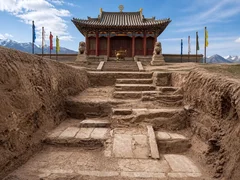
According to Ministry of Culture of the Kyrgyz Republic, archaeological research has been ongoing since early May 2026 at the Shakhristan-2 site. During the excavations, scientists discovered stairs, a ramp, and a platform built of fired brick. Such architectural elements are characteristic of temple structures from the Tang Dynasty. The discovered objects confirmed the hypothesis of renowned archaeologist Alexei Bernshtam, put forward in the late 1940s, regarding the existence of a Buddhist temple complex in this area.
Excavations in 2025–2026 provided new scientific data on the spread of Buddhist culture in the ancient city of Suyab, one of the key centers of the Great Silk Road. From the 6th to the 11th centuries, Suyab was the capital of the Western Turkic Khaganate.
The expedition has been operating since 2012. It is led by Bakyt Amanbaeva, a professor at the National Academy of Sciences, on the Kyrgyz side, and Kazuya Yamauchi, a professor at Teikyo University, on the Japanese side.
Work is currently underway to restore the site's status as a historical and cultural site. If the decision is positive, an open-air museum is planned for the future. It should be noted that in 2014, the Ak-Beshim (Suyab) settlement was included in the UNESCO World Heritage List as part of the transnational nomination "The Silk Roads: the Route Network of the Chang'an-Tien Shan Corridor."