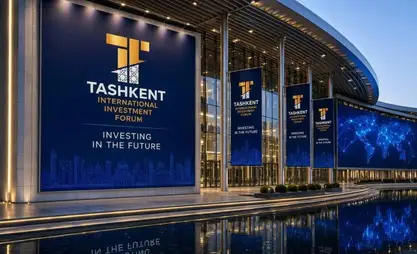
On June 17 this year, the plenary session of the 5th Tashkent International Investment Forum was held in Tashkent, Uzbekistan. The event brought together President of the Republic of Uzbekistan Shavkat Mirziyoyev, President of the Republic of Albania Bajram Begaj, Chairman of the Government of the Russian Federation Mikhail Mishustin, Prime Minister of the Republic of Azerbaijan Ali Asadov, Prime Minister of the Republic of Belarus Alexander Turchin, Prime Minister of the Republic of Kazakhstan Olzhas Bektenov, Chairman of the Cabinet of Ministers and Head of the Presidential Administration of the Kyrgyz Republic Adylbek Kasymaliev, Prime Minister of the Republic of Tajikistan Qohir Rasulzoda, President of the New Development Bank Dilma Rousseff, as well as representatives of multilateral financial institutions, foreign banks, global corporations, major companies, investment funds, and business communities.
The forum gathered more than 10,000 delegates and participants from over 100 countries, further confirming its growing international stature and demonstrating the increasing confidence of the global community in the reforms being implemented in New Uzbekistan.
Having become one of the most important international platforms for investment and economic cooperation in Central Asia, the Tashkent International Investment Forum once again served this year as a key venue for discussing pressing issues on the regional and global economic agenda. The initiatives and priority areas presented during the forum indicate the beginning of a new phase in Uzbekistan’s economic policy.
In recent years, the country’s strong economic growth and increasing inflow of foreign investment have made Uzbekistan one of the most attractive markets for the international business community. The forum held in Tashkent demonstrated that this process is not accidental but rather part of a long-term strategic vision.
Last year, Uzbekistan’s economy grew by 7.7 percent, while the country’s gross domestic product is expected to exceed $180 billion this year. The volume of attracted investments reached $43 billion. Strengthened macroeconomic stability has been one of the key achievements: the national currency has remained stable, while international reserves have surpassed $70 billion.
Over the past years, Uzbekistan has attracted more than $150 billion in foreign investment, with $123 billion of that amount secured during the last five years alone. At the same time, the country continues to strengthen its position in international rankings. Notably, Uzbekistan was included for the first time among the countries classified as having a “moderately free economy” in the Economic Freedom Index.
It should be noted that the global economy today is being reshaped by geopolitical tensions, changing supply chains, and technological transformation. Under such circumstances, investors place significant importance not only on resources but also on legal guarantees, financial stability, and a predictable business environment.
One of the key messages of the Tashkent Forum was precisely the commitment to meeting these expectations. The plans announced by the country’s leadership to align legal protection mechanisms with international standards, establish new financial institutions for investors, and further develop arbitration systems were welcomed as important developments by foreign investors.
This is particularly significant for institutional investors, who carefully assess legal risks when entering emerging markets.
– It is no exaggeration to say that the most important partner in turning ambitious visions into reality is an investor with good intentions. Therefore, the doors of New Uzbekistan will always remain open to foreign investors who come to our country with trust and ideas. As President, I personally, together with our Government, stand ready to work alongside you as reliable and committed partners, President Shavkat Mirziyoyev said in his address.
Another important conclusion emerging from the discussions is that Uzbekistan no longer intends to rely solely on raw materials or traditional industries. Industrial modernization, the expansion of high-tech manufacturing, and increasing the share of export-oriented products are being positioned as the pillars of the country’s new economic model. The emphasis placed on sectors such as chemicals, machinery manufacturing, pharmaceuticals, electrical engineering, and digital technologies demonstrates Uzbekistan’s intention to integrate more deeply into global production chains.
Particularly noteworthy is the growing focus on processing critical mineral resources into higher-value products, which opens new opportunities for international investors. At a time when global demand for lithium, copper, rare earth elements, and other strategic raw materials is rapidly increasing, Central Asia is acquiring growing geoeconomic significance in this field.
The Tashkent Forum also highlighted the central role that energy and digital technologies occupy within the country’s economic strategy.
In recent years, renewable energy projects have been transforming Uzbekistan into one of the largest green energy markets in the region. Alongside the construction of solar and wind power plants, plans to develop energy storage systems and modern electricity grids are expected to strengthen the country’s long-term energy security.
At the same time, the increased focus on artificial intelligence deserves special attention. Whereas digital transformation was previously associated primarily with the modernization of public services, the country now aims to create new value across all sectors of the economy through the widespread adoption of AI-driven solutions.
This direction is important not only for attracting technology investments but also for developing a highly skilled workforce capable of supporting future economic growth.
Among the issues discussed at the forum, transport and logistics infrastructure also occupied a prominent place. For Uzbekistan, a landlocked country, international transport corridors remain a crucial factor in economic development.
Railway and transit projects linking China with European markets through Central Asia have the potential to significantly enhance Uzbekistan’s strategic position on the regional transport map. According to experts, if the planned infrastructure projects are fully implemented, Uzbekistan could emerge as one of the region’s major logistics hubs. This would not only increase transit revenues but also create new opportunities for industrial expansion and foreign trade growth.
One of the factors attracting investors’ attention is Uzbekistan’s demographic potential. Rapid population growth, accelerating urbanization, and rising demand for housing are creating a vast market for construction, infrastructure, utilities, and service industries.
The Tashkent International Investment Forum served not only as a platform for attracting investment but also as an opportunity for Uzbekistan to present its vision of the country’s economic future to the international community.
The initiatives announced during the forum indicate the emergence of three major trends in Uzbekistan’s economic policy: deepening institutional reforms, transitioning toward a high-tech economy, and strengthening regional integration.
If these plans are implemented consistently, Uzbekistan could become not only one of Central Asia’s largest consumer markets but also a regional center for investment, logistics, and innovation. The Tashkent Forum may well be remembered as another important milestone on the country’s path toward achieving these ambitions.
Utkir Alimov,
UzA