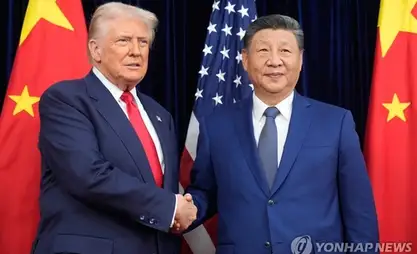
U.S. President Donald Trump and Chinese President Xi Jinping held a high-stakes summit Thursday as global attention focused on whether progress was made to ease the two countries' trade war marked by tit-for-tat tariffs, Yonhap reported.
The two leaders met for the first time since 2019 at Naraemaru, a reception hall inside an Air Force base in the southeastern city of Busan, shortly after Xi arrived in the country for a three-day state visit.
There was no immediate comment from either side after the conclusion of the talks, which China's CCTV said lasted for 1 hour and 40 minutes.
Trump could be seen speaking into Xi's ear as they left the building together. He departed South Korea for Washington shortly afterward, while Xi's motorcade headed to the nearby city of Gyeongju, where he will attend the Asia-Pacific Economic Cooperation (APEC) summit.
During the opening of their talks, Trump praised Xi for being a "great leader of a great country."
"I think we've already agreed to a lot of things, and we'll agree to some more right now," he said.
Xi offered a more nuanced assessment, noting it is "normal" for the two leading economies of the world to "have frictions now and then."
"In the face of winds, waves and challenges, you and I, at the helm of China-U.S. relations, should stay the right course and ensure the steady sailing forward of the giant ship of China-U.S. relations," Xi said. "Our two countries are fully able to help each other succeed and prosper together."
At stake was a potential agreement that China would hold off on tightened export controls on rare earths for a year in exchange for the United States canceling its planned imposition of an additional 100 percent tariff on Chinese goods starting Nov. 1.
A framework agreement on such a deal was reportedly reached between officials of the two sides over the weekend.
The world's two largest economies have other trade issues to resolve as well. China stopped buying soybeans from the U.S. this year, hurting American farmers who are a key Trump voter base. The U.S. has separately used tariffs to pressure China to stop the flow of fentanyl.
Trump indicated Wednesday that he would lower the fentanyl-related tariffs, which currently stand at 20 percent, in exchange for Beijing's commitment to curbing exports of chemicals that can be used to make fentanyl.
The trade war between the two superpowers saw U.S. tariffs on Chinese goods climb to 145 percent in April, while Chinese tariffs on U.S. goods rose to 125 percent.
Following a truce reached at high-level trade talks in May, the taxes have currently been lowered to a total of 50 percent on Chinese goods and 10 percent on U.S. goods.
Few observers expected the summit to end the trade war between the two countries, but any agreement that eases the uncertainty surrounding their punitive measures could be a first step.
Security issues are also a large component of the U.S.-China rivalry as Beijing appears to flex its military muscle on the continent.
Chief among them are North Korea's evolving nuclear weapons program, China-Taiwan tensions and Beijing's territorial claims in the South China Sea.
Trump indicated Wednesday that Taiwan may not feature prominently in his talks with Xi.
"I don't know that we'll even speak about Taiwan," he told reporters aboard Air Force One. "I'm not sure. He may want to ask about it. There's not that much to ask about. Taiwan is Taiwan."